
 Download Here
Research Brief · September 2026
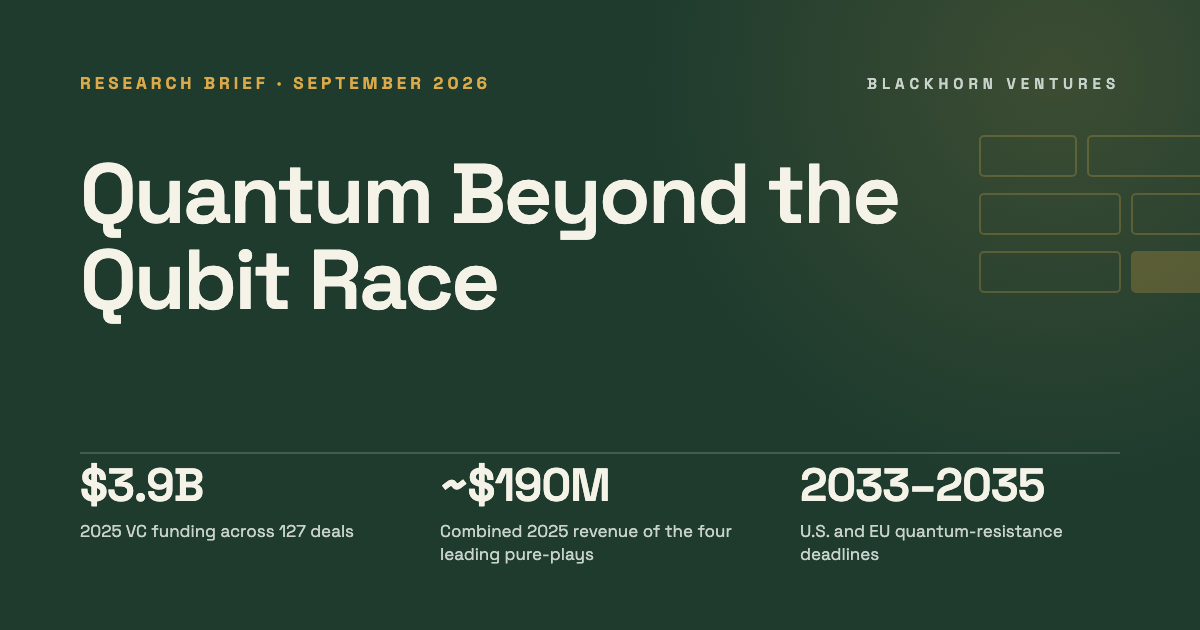
Quantum Beyond the Qubit Race
$3.9B
2025 VC funding across 127 deals — a record, and an inflection as an asset class.
~$190M
Combined 2025 revenue of the four leading pure-play quantum computing companies.
2033–2035
Deadlines by which U.S. and EU systems must be quantum-resistant.
Quantum gets discussed as a single technology with a single arrival date. It is not. This summer we mapped the landscape across three sub-sectors — sensing, communications, and computing — plus the enabling layer beneath all three. They are scientifically intertwined but commercially staggered.
1. Quantum is three markets, not one — and they ship at different times
Sensing uses the sensitivity of quantum states to measure rather than compute, so it does not wait on fault tolerance: devices with tens to hundreds of atoms already outperform classical alternatives in the field. Communications splits cleanly in two: post-quantum cryptography is a live software migration happening now, while quantum networks are gated on quantum repeaters and quantum memory that do not yet exist. Computing holds the largest projected value and sits furthest from deployment. Beneath all three sits a shared enabling layer: lasers and optics, control electronics, cryogenics, fabrication, middleware. These layers are where a bottleneck solved captures demand regardless of which modality or timeline wins.
2. Capital has inflected. But the buyer is still the lab.
2025 set a funding record at $3.9B across 127 deals, Q1 2026 exit value hit $5.7B (roughly 15× the 2023–25 total combined) and cumulative public commitments now exceed $56B. However, revenue has not followed. Quantinuum booked $30.9M in 2025 against a $192.6M loss, and Q1 2026 revenue fell 73%. Across IonQ, Quantinuum, D-Wave, and Rigetti, combined 2025 revenue was roughly $190M, nearly all of it R&D access, government programs, and system sales to labs. Consensus forecasts project steep scaling, but the base that is scaling is procurement and research budgets. And a forecast is not a customer.
3. The state has crossed from funder to shareholder
In May 2026, the U.S. Department of Commerce committed over $2B across nine quantum firms in exchange for non-controlling equity stakes ($1B to IBM for a superconducting foundry subsidiary, $375M to GlobalFoundries for a modality-agnostic foundry, and roughly $100M each to Atom Computing, D-Wave, Infleqtion, PsiQuantum, Quantinuum, and Rigetti). It is explicitly a portfolio approach, spread across neutral-atom, silicon-spin, superconducting, photonic, and trapped-ion architectures rather than picking one. Governments are now shaping demand directly, not just funding it; the same is true on the security side, where CNSA 2.0 and NIST's deprecation timeline manufacture buyers years ahead of any proven quantum advantage.
4. Where commercial reality arrives, so does consolidation
The clearest pattern across all three sub-sectors: the layers that become real also become contested. IonQ absorbed roughly $2.7B in acquisitions spanning computing (Oxford Ionics), sensing (Vector Atomic), and communications (ID Quantique, Qubitekk, Skyloom). Quantum Design picked up Qnami and Oxford Instruments NanoScience in sensing. Five SPAC listings landed in H1 2026 alongside Quantinuum's June IPO at roughly a $15B valuation. Below the incumbents, IBM and Nvidia give away tooling to sell hardware and cloud. Between consolidation above and free tooling below, an early-stage company needs a durable performance edge, not a wrapper.
5. Where the openings sit (and where they do not)
The space that remains open for an early-stage investor like Blackhorn is narrower than the headlines imply. And the opportunity should not require a bet on when fault-tolerant quantum computing arrives. Three areas appear to be the best fit for our investment strategy:
Sensing application layer. The sensor hardware market is not venture-scale on its own, and it is commoditizing; synthetic diamond wafer prices for NV-center sensors fell roughly 40% in 2025 and off-the-shelf OPM magnetometers are available today. Durable margin migrates up to companies that buy commodity components and sell decision-grade data into existing industrial budget lines: emissions compliance, utility inspection, subsurface mapping, GPS-denied autonomy. In these instances, quantum is virtually invisible to the buyer.
OT crypto-agility. PQC is a thin wedge in enterprise IT, where it arrives silently via browser, OS, and cloud updates. It is not thin in operational technology: substations, SCADA, controllers, and metering with 15–25-year field lives, no over-the-air patch path, and protocols that assume yesterday's cryptography. Migrating those assets is a services-heavy-then-product market on the utility CISO's desk, with a regulatory forcing function and a dated deadline. The quantum computer never has to work for this commercial budget line to be real.
Quantum-secondary suppliers. Precision and advanced-manufacturing software where quantum fabs are one customer segment among many. These businesses carry less timeline risk: they are underwritten on their existing commercial market and get quantum as upside optionality.
The quantum applications that intersect our investment verticals (grid and logistics optimization, molecular simulation for batteries and carbon capture) sit downstream of fault tolerance, which means two stacked waits: hardware maturity, then a venture-fundable application company on top of it. That is generally longer than our current fund life. And the customers paying today are the quantum industry itself, national labs, and defense, not the operators, fleets, and asset owners where our edge lives.
6. What we’re tracking
Our posture is readiness with a conservative entry, not avoidance. AI may compress these timelines faster than consensus assumes. Five signals represent a catalyst for investment: useful circuit depth rather than logical qubit counts; convergence toward one or two qubit modalities, which would erode the case for a modality-agnostic layer; seed capital re-entering a category where it is currently about 2.4% of quantum-computing venture dollars; pilots converting to paid production; and a sensing application company crossing roughly $10M ARR from non-defense, non-research customers. On compliance, the signal is enforcement, not publication; standards have existed since 2024, the budget line appears when someone is held to them.
For Blackhorn Ventures, the most credible near-term opportunities attach quantum capabilities to existing industrial budgets and regulatory deadlines. Tracking this space or building here? We’d love to compare notes!
Sources: QED-C State of the Quantum Industry 2026; Bit by Qubit / PitchBook Q2 2026; McKinsey Quantum Technology Monitor 2025–2026; OECD Quantum Technologies Policy Primer; NIST IR 8547 and NSA CNSA 2.0; U.S. Department of Commerce announcements (May 2026); Cloudflare; company filings and announcements from IBM, IonQ, Quantinuum, D-Wave, Rigetti, QuEra, Google and others (2024–2026). Figures are estimates drawn from public reporting. This summary is provided for informational purposes only. It is not investment advice, an offer of securities, or a recommendation regarding any company mentioned.


BLACKHORN VENTURES and the BLACKHORN VENTURES logo are registered trademarks of Blackhorn Ventures.