
The veteran on the floor
Almost every industrial operator has seen some version of this.
A piece of equipment starts behaving strangely. Nothing alarming. Just different. A subtle vibration. A temperature reading that is still within spec but moving in an unusual way.
The veteran on the floor walks over, listens for a moment, and says, “That's what it did in 2019, right before the coupling went. Shut it down.”
And they're right.
That judgment is not in a manual. It comes from remembering what happened on this machine, under similar conditions, years earlier. It is also the kind of intelligence that walks out the door when an experienced operator retires.
Most AI systems have no equivalent. They can process the current sensor reading or a recent window of telemetry, but they do not remember that this vibration pattern appeared three times before and preceded the same failure twice. They treat each inference as a new problem.
The best operators do the opposite. They reason from precedent.
The operating advantage is not knowing more in the abstract. It is remembering what happened here, under these conditions, and retrieving it before the next decision.
What compounding memory actually means
Compounding memory turns operational history into usable precedent. It has three jobs.
Working context tracks what is happening now: current conditions, recent actions, active constraints, and unfinished tasks. It knows that the pour schedule moved and the wind is rising.
Episodic history preserves what happened before, including the conditions, the decision, and the eventual outcome. It remembers the coupling failure in 2019 and the vibration pattern that came first.
Shared retrieval puts the right precedent in front of every authorized agent and operator when it matters. A lesson learned by a maintenance agent should not remain trapped there if a scheduling agent also needs it.
The moat is not the data exhaust. It is the system's growing ability to connect a present condition to relevant precedent, recommend an action, and learn from what happened next.
Consider a pump that develops an unusual vibration during a stretch of high humidity. The system finds three similar episodes in the facility's history. Two ended in bearing failures within 72 hours. In the third, the team replaced the bearing early and avoided an outage. It also finds that rerouting production during the repair cut downtime by 40 percent.
Now the system can do more than flag an anomaly. It can recommend a bearing inspection, explain why, and propose a production plan based on what worked before. A predictive model may still be part of the answer, but the decision is grounded in the facility's own history rather than a generic model alone.
That is institutional knowledge embedded in infrastructure.
Formic, one of our portfolio companies, is already building this advantage at fleet scale. The company deploys industrial robots as a service and has accumulated more than 400,000 production hours across its customer base. Its Colony command center uses operating telemetry to detect drift, anticipate wear, and improve future deployments. Every hour of uptime produces revenue. It also creates another labeled example of how a machine behaved, what the team did, and what happened next.
The loop begins with capture. A system cannot learn from a condition it never observed or an outcome it never recorded. That is why the aging industrial workforce matters so much. Experienced operators hold years of pattern recognition that most organizations have never captured in a usable form.
Over time, parts of this learning may travel beyond a single operator. An opt-in exchange could pool anonymized failure modes, welding-quality data, or surface-finish outcomes across companies in the same vertical. The technical work is possible. The harder questions are incentives, data rights, liability, and trust. If those can be solved, the network could learn from far more operating experience than any one company can generate.
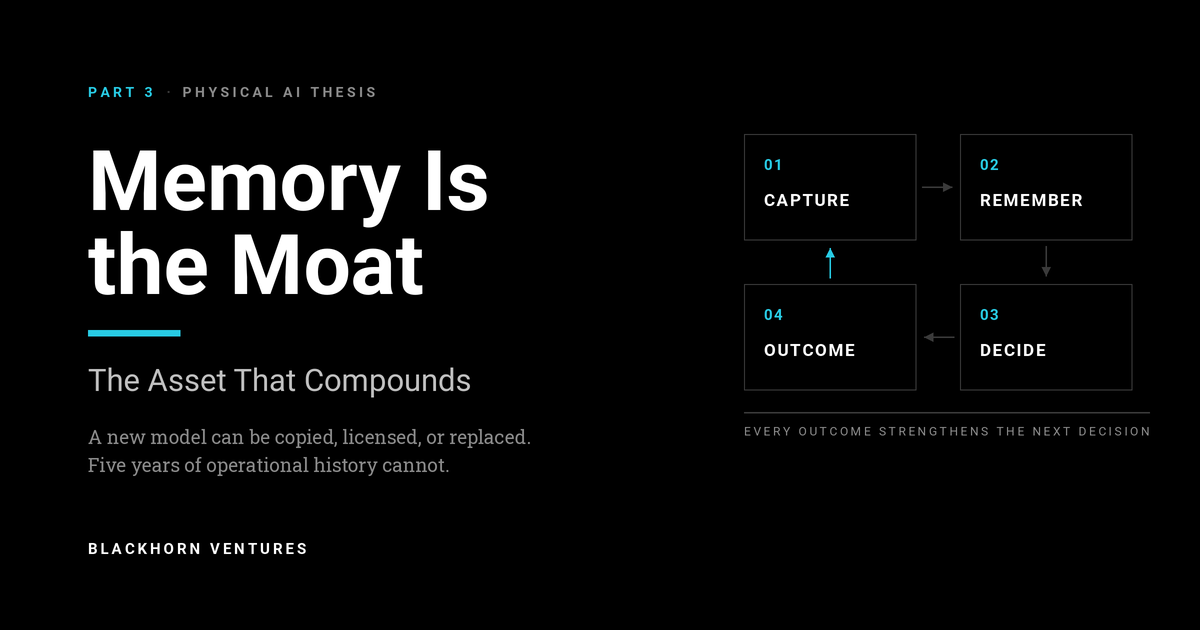
A new model can be copied, licensed, or replaced. Five years of structured history tied to specific machines, sites, interventions, and outcomes cannot be recreated on demand. That accumulated decision advantage is the moat.
Every outcome strengthens the next decision.
Operational history becomes retrievable precedent, not disposable exhaust.
Turn operations into a record
Frontline voice · sensor telemetry · work orders · images · environmental context
Act with precedent
A specific action and rationale grounded in this facility's own history
Observe what actually happened
Did the weld hold? Did the failure materialize? Did the intervention work?
What memory looks like in four verticals
The mechanism is the same across industries. What changes is the history worth remembering.
Manufacturing and robotics
The binding constraint in manufacturing is not whether one robot can perform one task. It is whether robots, people, and machines can coordinate across an entire production workflow.
Falling hardware costs will bring more capable actuators onto the factory floor. Goldman Sachs reported that humanoid manufacturing costs fell by roughly 40 percent between 2023 and 2024. But cheaper hardware does not solve coordination, and it does not close the quality loop.
Suppose a weld passes visual inspection today and fails under fatigue six months later. The operation learns only if it can connect that failure to the original material batch, process settings, robot path, environmental conditions, and inspection result. Once that link exists, each downstream outcome can improve the next production run.
The individual robot does not need to be brilliant. The production system does.
Energy and utilities
The grid is a natural fit for this architecture. It is complex, safety-critical, heavily instrumented, and governed by strict operating rules. It is also changing quickly as renewable generation, storage, electrification, and aging infrastructure alter familiar load patterns.
Imagine a substation engineer coordinating protective relays on a feeder with new distributed solar. The neural system recognizes an unusual loading pattern and retrieves similar reconfigurations from the utility's history: the settings used, the approvals required, and the operating results that followed. A deterministic tool then runs the fault-current calculation against the applicable coordination curves. The engineer gets an answer grounded in both physics and precedent, with an audit trail.
ThinkLabs AI, a Blackhorn portfolio company spun out of GE Vernova, is building an operator-facing system around this intersection. Its advantage depends on understanding both modern AI architecture and the century-old physics of the grid.
Logistics and supply chain
Manufacturing coordinates work inside a relatively controlled environment. Logistics coordinates work across environments no single operator controls.
The useful history is granular: this route floods during spring storms; this customer rejects deliveries after 4 p.m.; this dock runs 20 percent slower on Mondays. But memory becomes valuable only when the system connects those facts to decisions and outcomes. Did rerouting reduce miles without hurting service? Did moving the appointment cut detention time? Did a different carrier perform better under the same conditions?
No single observation creates much advantage. Thousands of these feedback loops can separate a profitable network from one that operates on thin margins and constant firefighting.
Construction
Construction may offer the largest opening because so little operating history is captured cleanly today. Every project is different, and its data is scattered across BIM models, schedules, inspection PDFs, crane telemetry, delivery systems, and regulatory records.
Artic is built around one of these seams. The company coordinates schedules, drawings, quality records, and delivery sequencing across the handoff between off-site manufacturing and on-site installation.
The deeper opportunity is not merely integrating those systems. It is remembering which plans failed, which sequencing changes recovered time, which site conditions created quality problems, and which interventions worked. A general contractor running 50 active, instrumented sites would have 50 parallel learning environments. Each project could improve the next one.
The mechanism stays constant. The memory changes.
Each vertical compounds a different form of operational precedent.
Process history → quality decisions
Material batch, machine path, settings, inspection, downstream failure.
Grid state → safe intervention
Configuration, approvals, fault calculations, and observed operating result.
Network conditions → routing choices
Weather, dock behavior, carrier performance, service and margin outcomes.
Project sequence → execution playbook
Site conditions, handoffs, delays, quality issues, and recovery actions.
Where durable value will accrue
We invest in industrial technology, so this is a market view as much as a technical one.
The standard application-layer thesis says foundation models will become commodities and value will move downstream. Physical AI is more complicated. Better multimodal reasoning, world models, simulation, and vision-language-action systems will expand what industrial applications can do. Foundation progress is an input, not necessarily a threat.
But it will also produce a flood of thin products: AI-generated maintenance reports, safety dashboards, and inspection summaries. An LLM that summarizes Procore alerts may be useful. It is not orchestration, and it does not create a durable memory advantage.
The companies worth watching are doing hard work the foundation layer will not do for them: training for a specific physical domain, routing between neural and deterministic systems under real regulatory constraints, indexing years of multimodal history, closing sim-to-real loops, or building capture infrastructure where none exists.
We expect durable value in four parts of the stack:
- foundation systems that materially improve physical reasoning;
- vertical orchestration platforms that understand industry-specific workflows, rules, and approval chains;
- operators that capture their own history and use it to improve decisions;
- memory infrastructure that makes operational precedent retrievable, traceable, and eventually shareable.
These categories will overlap. The strongest companies may span several of them.
Circuit Mind, another Blackhorn portfolio company, shows what domain depth looks like. It generates electronics schematics and optimized bills of materials by combining AI with component physics and constraint solving. That capability does not fall out of a general model prompt. It comes from doing the underlying work.
The risk is building a thin interface and mistaking access to a model for defensibility. The opportunity lies where domain work and accumulated operational history reinforce each other.
Industrial operators are already sitting on the raw material: years of experience that still disappears one retirement at a time. The companies that turn that history into infrastructure will make better decisions today and widen the gap tomorrow.
From prediction to action
Return to the Houston job site where this series began.
It is the same Tuesday morning: a tower crane running lifts, a concrete pour scheduled on level 14, a shifted schedule, an unread inspection flag, and wind climbing toward the crane's operating limit. This time, the system is in place.
At 5:12 a.m., the orchestrator ingests the new weather forecast. It queries the crane manufacturer's load chart using the exact boom configuration and projected wind speed at 7:30.
At 5:14, it parses the previous day's inspection report and finds the rebar flag on the west elevation.
At 5:15, it cross-references the revised pour schedule and identifies the conflict. The crew is set to pour an uninspected section during a window when the crane cannot operate within its rated limits.
The system then retrieves similar schedule and weather conflicts from prior projects. It compares the interventions and their outcomes before recommending a new sequence.
At 6:15, the superintendent's phone buzzes. The alert explains the conflict, cites the supporting evidence, and recommends moving the west elevation pour to the afternoon, after the inspection and after the wind is expected to fall.
From fragmented signals to one safe decision.
The system connects what no single person or platform can see alone.
He confirms the change and updates the crew. Work proceeds on the remaining sections. The crane stays within its operating limits. Nobody gets hurt. Nobody makes the news.
Sixty-three minutes from signal to decision.
And the system remembers.
The next time a pour schedule shifts into a dangerous wind window, the conflict is no longer novel. The system has precedent: what it observed, what it recommended, what the superintendent changed, and what happened next.
That is what physical AI looks like when it works. Most of the time, it will not look dramatic. It will look like a problem that never happened and a decision that gets a little better each time.
The superintendent may never know how close the morning came to a different outcome.
That is the point.
Formic, ThinkLabs AI, Artic, and Circuit Mind are Blackhorn Ventures portfolio companies.


