
 Download Here
Physical AI · Part 2 of 3
Memory Is the Moat, Part 2: The Harness, Not the Model
The second of three essays on physical AI. Part 1 argued that world models give machines the capacity to reason about physics. This essay is about the layer that gives that reasoning a job site to operate on.
The Orchestration Gap
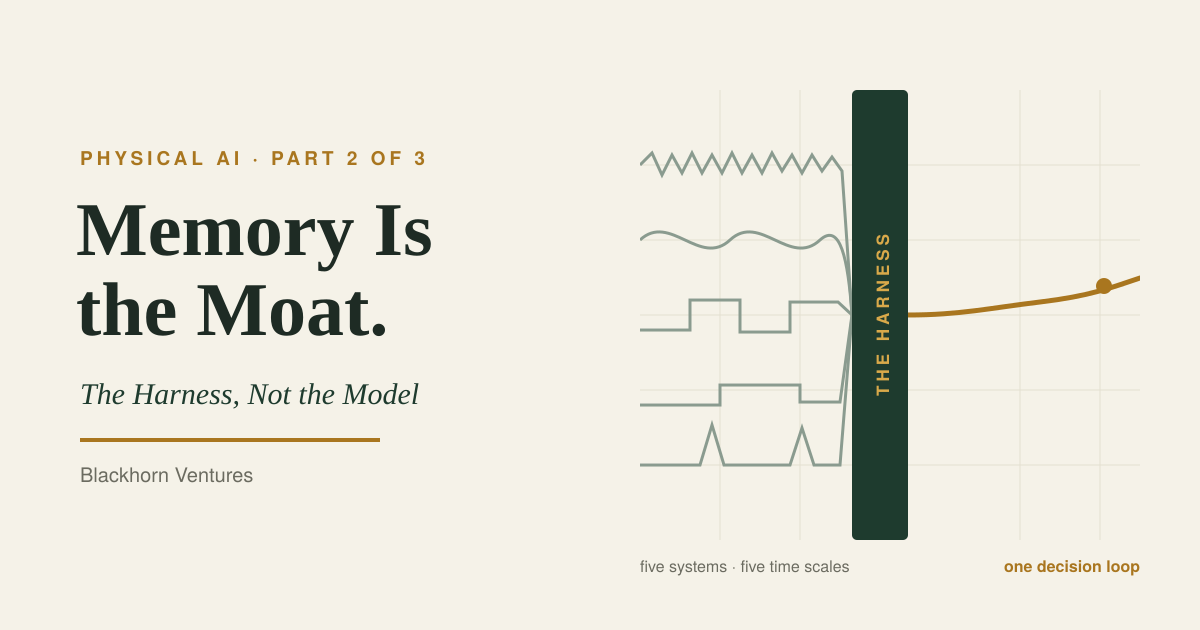
If world models give agents the capacity to reason about physics, orchestration is what gives them a job site to operate on. Walk through any industrial facility that's adopted AI in the last five years, and you'll find the same pattern. A predictive maintenance model on vibration data. A computer vision system doing quality inspection. A scheduling optimizer pulling from the ERP. Each works in isolation. None of them talk to each other. The maintenance model flags an anomaly on a pump but doesn't know the schedule just shifted. The scheduler builds a plan but can't incorporate the maintenance model's insight that Machine 3 is likely to go down in 48 hours. This is the orchestration gap, and it's the single biggest reason industrial AI has underperformed its promise.
We deliberately call this layer the harness. Not the platform, not the framework. The harness. Like a physical harness, its job is to hold multiple things together under load, distribute forces correctly, and keep people safe when something goes wrong. The harness has to do four things at once, and one thing over time.
Observability: you cannot operate what you cannot see
When an AI agent's decisions land in software, the worst case is a bad recommendation: recoverable, reversible. When they land in a physical environment, the consequences can be a dropped load, a missed weld, or an environmental release. Industrial agentic systems need end-to-end observability as a first-class requirement: structured logging of every inference, every tool call, every state transition.
Observability also depends on what the system can see in the first place. A meaningful share of what happens in industrial operations never enters any digital system, because it lives in the heads of frontline workers. Datch, one of our portfolio companies, lets technicians capture inspections, observations, and maintenance findings hands-free through voice, turning unstructured field knowledge into structured data the orchestrator can act on. You cannot orchestrate over what you never recorded.
Federation: coordinating without replacing
A modern industrial facility runs on geological layers of control systems: PLCs handling millisecond loop control, SCADA managing process state, MES tracking production flow, ERP orchestrating supply chain, and now AI models running at the edge and in the cloud. They speak different protocols on different time scales.
The orchestrator federates across all of them as a coordination layer above. The PLC still controls the valve. The SCADA system still monitors process state. The orchestrator decides whether the valve should be controlled differently given what the world model is predicting thirty minutes from now. The hardest version is bridging a thirty-year-old Modbus protocol and a modern transformer on an edge GPU into one coherent decision loop. Artic, another portfolio company, works the same problem in construction prefab: the factory's production cadence and the job site's ever-shifting schedule are two control systems that have never spoken. Artic keeps drawings, takt times, and delivery sequencing coherent across a hand-off that historically lost most of its information.
Deterministic where physics demands it
In software, probabilistic outputs are fine. On a factory floor, certain calculations must be exactly right. When an agent computes a load-bearing capacity, a crane's safe working radius at a given wind speed, or the fault current at a specific point in an electrical distribution system, you do not want a neural network approximating the answer. You want a physics-based calculation engine called with exact parameters returning exact results.
The orchestrator's job is to route pattern recognition, anomaly detection, and language understanding to a neural model, and physics-critical calculations to a deterministic solver. Getting it wrong doesn't produce a bad chatbot response. It produces a structural failure.
Safety as architecture, not a layer
Industrial environments produce consequences that cannot be undone. The orchestration layer has to encode that at three levels:
- Hard stops: actions never permitted regardless of what any model recommends — exceeding a rated load, operating outside certified temperature ranges, bypassing lockout-tagout. Enforced deterministically.
- Approval gates: actions that require human confirmation — changing a production recipe, committing to anything irreversible above a consequence threshold.
- Graceful degradation: when an agent fails or produces low-confidence outputs, the system falls back to known-safe defaults rather than freeze or hallucinate.
Architectures that treat safety as something you add later end up retrofitting it under regulatory pressure, which is both expensive and slow.
And over time: closing the loop
The orchestration layer is where the learning loop closes. Every action generates outcome data: did the weld hold, did the predicted failure materialize, did the rerouting actually reduce downtime? The orchestrator captures those outcomes, matches them against the predictions that produced them, and feeds the results back into model weights, routing logic, and the memory store. This is where the system stops being a collection of tools and becomes infrastructure that learns from its own operational history.
What Has to Be True
Two pieces of enabling infrastructure matter most.
Compute at the edge. Physical AI cannot round-trip to the cloud for every decision. A robot arm cannot tolerate 200 milliseconds of latency; a safety system monitoring crane operations cannot depend on an internet connection that might drop in a thunderstorm. The current hardware cycle, from NVIDIA's Blackwell generation to Vision-Language-Action models designed for edge GPUs, is about pushing inference to the point of action. Digital twins are the rehearsal side of the same requirement: world models need environments where they can rehearse millions of scenarios before ever touching a real asset.
Auditability by design. Standards bodies, insurance carriers, and regulators are watching early deployments. Companies that build auditable decision trails and safety-by-design now, rather than retrofitting them under pressure, won't just be well-positioned when standards crystallize. They'll shape what the standards say.
The Missing Layer
Back to the Houston job site that opened this series: a pour schedule shifted overnight, a rebar flag buried in an unread PDF, a wind forecast about to cross the crane's threshold. No single AI model will connect those three facts. An orchestrator does: by knowing which agents to invoke, in what order, with what data, and where the approval boundaries are.
But an orchestrator that can only see today is still missing what every veteran operator has. It doesn't remember that this combination of conditions has appeared before, or what happened next, or which intervention actually worked. It reasons brilliantly about the present and learns nothing from the past.
That missing layer, compounding memory, is the subject of Part 3. It's also where we believe the most durable value in physical AI will accrue. It's the reason this series carries the title it does.
Part 3, on compounding memory and where value concentrates, publishes next week.
Datch and Artic are Blackhorn Ventures portfolio companies.


BLACKHORN VENTURES and the BLACKHORN VENTURES logo are registered trademarks of Blackhorn Ventures.