
 Download Here
Summary
The US construction industry is a deeply interdependent system that underpins much of the physical economy. As construction output and project complexity have increased over decades, delivery timelines have remained largely unchanged, reflecting limited improvement in execution performance despite advances in planning and digital tools. Most persistent productivity losses arise at the intersections of workflows. Traditional construction field enablement tools focus on the individual worker, but our research shows that productivity is shaped just as much by supervisors, planners, designers, and procurement teams whose decisions define daily workflow.
Field Enablement
We define field enablement as the ability for jobsite teams to access the right information, tools, and coordination infrastructure at the moment of execution, spanning training, productivity, and safety to remove friction from day-to-day work. It’s not just digitization, it’s any operational intervention that removes friction and accelerates high-quality work.
Across interviews with field-level practitioners and adjacent operational roles across the construction lifecycle, and mapping out workflows, eight recurring field-level pain points emerged across trades and project types, indicating structural rather than role-specific challenges. By analyzing how these pain points cluster, we identified five opportunity areas with the greatest potential to improve frontline productivity and system-level coordination simultaneously.

I. Introduction
At Blackhorn Ventures, we invest in industrial impact; focusing on asset-light technologies that drive resource efficiency and productivity across the physical world. We believe that optimizing how physical work gets done, by people, with tools, across complex systems, is fundamental to improving industrial performance, profitability, and sustainability. Where possible, we prioritize tooling that not only boosts productivity but also advances decarbonization by reducing energy use and material waste. Labor is not just a cost center; it is a core constraint and a leverage point when supported by better tooling, coordination, and decision-making infrastructure.
This thesis has led us to invest in companies like Toggle, which automates rebar fabrication using robotics and software to improve safety and throughput, and Hyperframe, which re-engineers steel framing into a tool-free, snap-together system that accelerates installation and reduces jobsite labor requirements. Both demonstrate how targeted interventions can unlock productivity at the task level.
“Labor is not just a cost center; it is a core constraint and a leverage point…”
Many existing construction-tech solutions address only narrow pain points in the construction lifecycle. Our research, drawing on industry studies and interviews with active construction teams, points instead to persistent inefficiencies rooted in how roles interact, how work is sequenced, and how information moves across phases. In tightly coordinated, sequential systems, even small breakdowns in these areas can create significant downstream friction that constrains productivity at the system level.
The scale of value at stake is substantial. The U.S. construction sector generates roughly $2.2 trillion in annual output according to the Census Bureau, and labor typically accounts for 20-40% of project costs, according to industry analyses. Even modest improvements in frontline productivity therefore translate into meaningful value: a 1% gain in labor efficiency unlocks an estimated $20-40 billion in economic impact each year. Yet despite this scale, labor productivity remains one of the industry’s most persistent challenges.
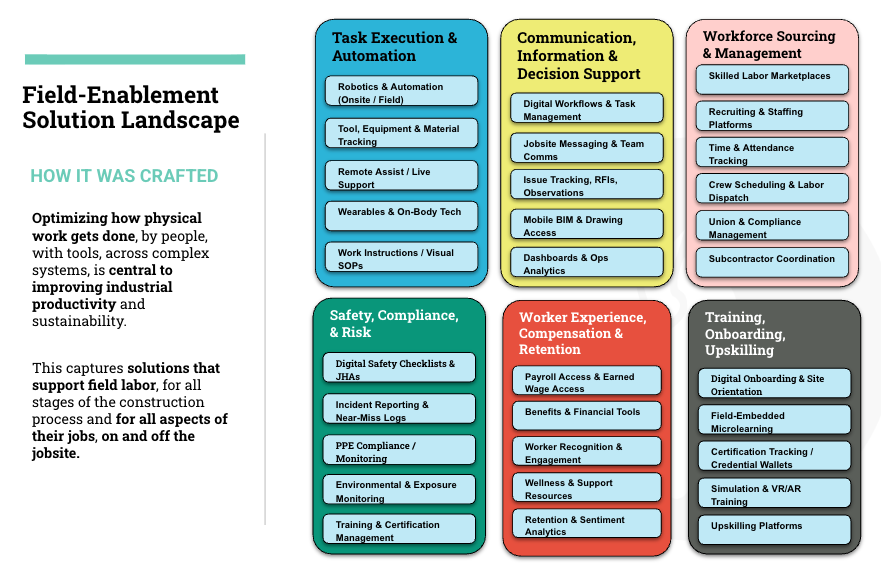
Taxonomy for Traditional Field Enablement Solutions (via Blackhorn Ventures)
While many tools support the individual worker, several also begin to address the coordination and information flow challenges that drive system-level inefficiencies. We believe the greatest opportunities for value creation exist in solutions that have the potential to improve both individual productivity and the performance of the construction system as a whole.
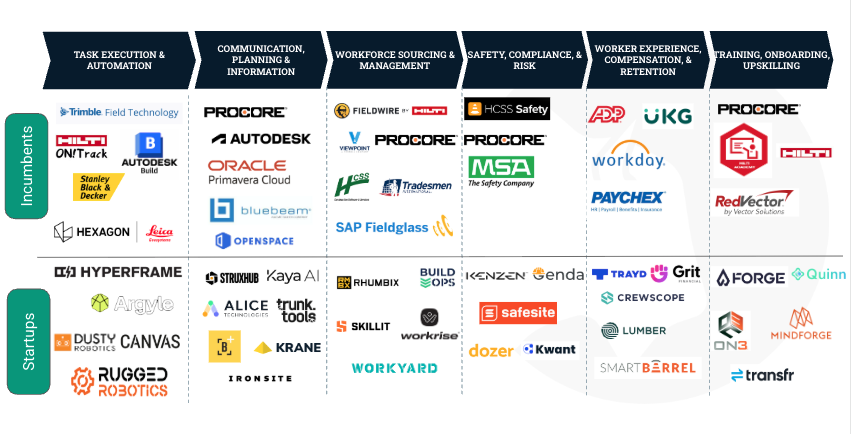
This market map is a sample of companies that fall under each category for traditional field enablement solutions
While many of the solutions in the market landscape above–like the robotics solutions, for example–aim to resolve a single issue the field worker faces, there are others that extend to other stakeholders and coordination points that can determine project velocity. Quinn, for example, is a mobile-first training solution that supports onsite work execution at the trade level, but extends to project managers, superintendents, and foremen. As we explore new opportunities in field enablement, we look beyond individual trades to the field as an interconnected system to identify solutions that strengthen field execution while unlocking productivity and efficiency gains across the construction ecosystem as a whole.
II. Macro Context
While the AI data center buildout has been a boon to the US construction workforce, the industry faces structural challenges: a shrinking workforce, stagnant productivity, and increasingly complex operations. The U.S. construction sector is short over 500,000 skilled craft workers annually, a gap expected to persist through 2030. Compounding the issue: nearly 40 percent of the workforce is on track to retire by 2031, according to Bureau of Labor Statistics projections. A smaller workforce has a direct impact on delivery timelines, safety, and project cost.
The U.S. construction sector is short over 500,000 skilled craft workers annually, a gap expected to persist through 2030.
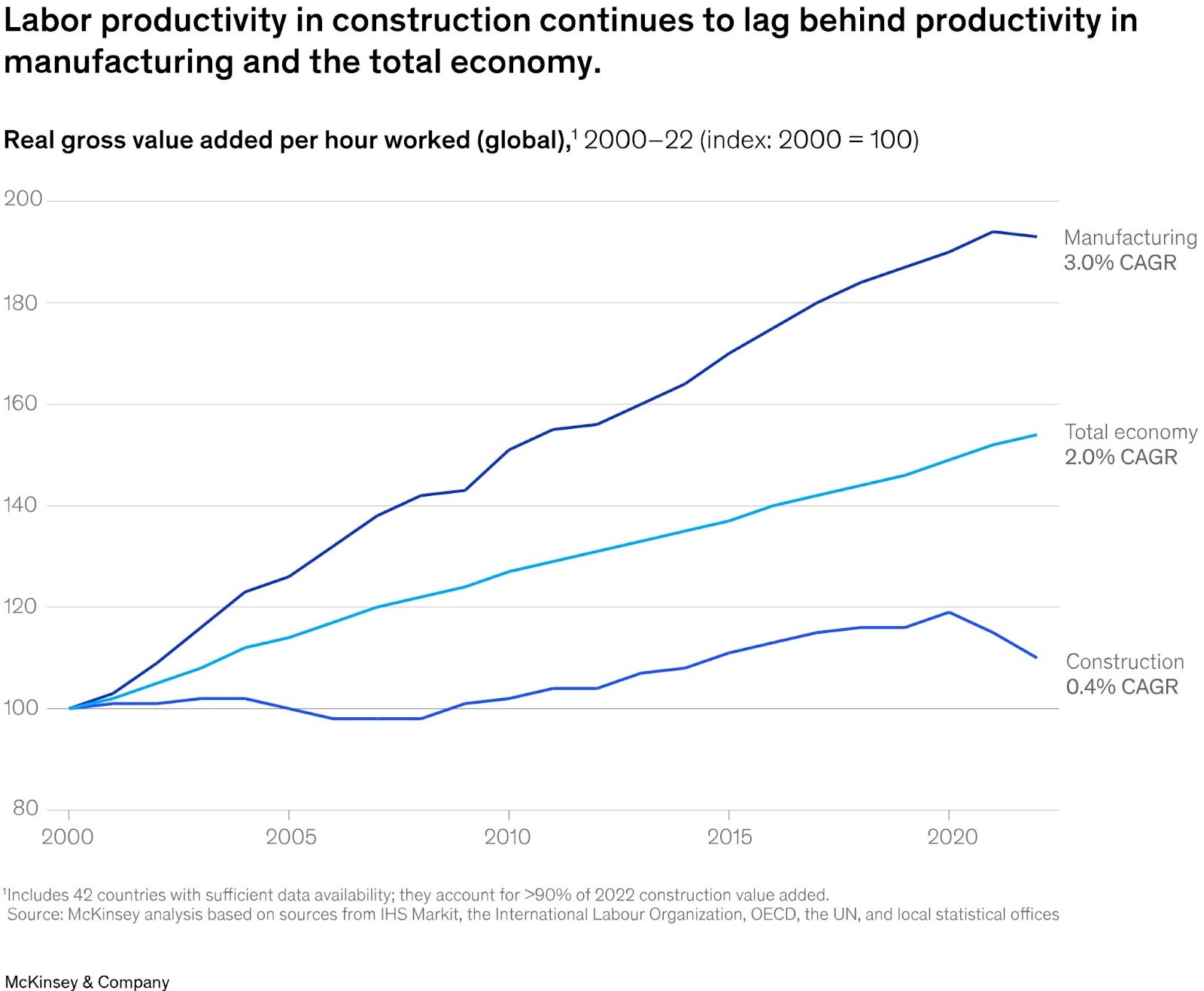
At the same time, construction continues to lag behind peer industries on productivity. Over the past two decades, global manufacturing productivity has risen nearly three percent annually, while construction has struggled to reach one percent. A well-circulated McKinsey analysis shows construction productivity remaining essentially flat over a multi-decade span, creating a roughly 20-point gap relative to other industrial sectors.
Recent federal legislation, such as the One Big Beautiful Bill Act and the CHIPS and Science Act, is driving a wave of new infrastructure, clean energy, and manufacturing projects that are expected to significantly increase construction demand over the next decade. As this demand accelerates, the industry’s heavy reliance on immigrant labor exposes a growing structural risk. Nearly 30% of U.S. construction workers are immigrants (with much higher shares in major building states like CA, TX, and NY), and recent enforcement crackdowns and evolving immigration regulations are already contributing to worker shortages. A 2025 AGC survey found 28% of contractors impacted by enforcement actions in just six months, with many reporting project delays or workforce losses. In a sector facing rising demand, this makes labor supply a material constraint, not just a near-term inconvenience.
III. Field Productivity Pain Points
Through workflow mapping, role-based analysis, and field interviews, we identified two underlying patterns that explain the majority of pain points:
Systemic Coordination Breakdowns: Construction depends on tightly sequenced handoffs. When instructions, updates, or dependencies do not reach the right people at the right time, delays, rework, and cascading inefficiencies follow.
Proliferation of Point Solutions: Field teams navigate a mix of paper workflows, disconnected apps, and role-specific tools that fail to align planning with real field conditions. This fragmentation obscures root causes and slows decision-making.
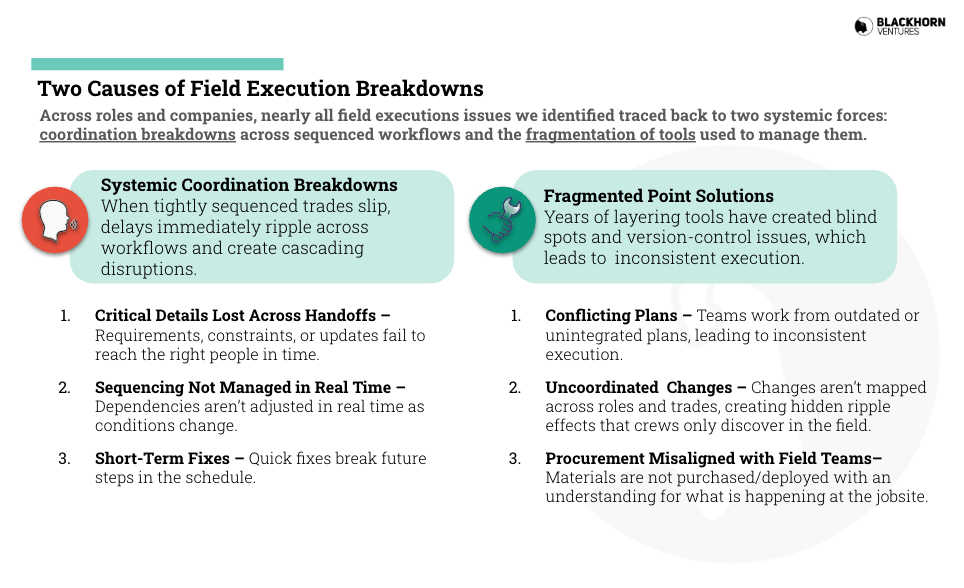
While these two systemic forces drive many of the highest-impact issues we heard from the field, crews also face other recurring on-the-ground challenges that slow execution. Together, these form the eight field productivity pain points below.
1. Physical Strain & Injury Risk: Repetitive strain, heavy handling, and overhead work slow execution and lower crew efficiency.
2. Frequent Task Interruptions: Workers are pulled off tasks for rework, coordination questions, or cleanup, breaking focus and rhythm.
3. Poor Instructions / Unclear Training: Ambiguous or missing specs, outdated markups, inadequate training, or verbal-only direction.
4. Field Communication & Readiness: Outdated plans, slow updates, unresolved RFIs cause delays for crews or cause rework.
5. Trade & Task Coordination: Disjointed sequencing and unclear handoffs between trades.
6. Material Coordination & Site Logistics: Mistimed deliveries and poorly staged materials leading to idle workers.
7. Quality Assurance & Inspections: Delays and failures in quality checks lead to re-work and compounding costs, particularly in late stages.
8. Schedule Creation & Updates: Schedules diverging from real-time field conditions lead to workers conducting “reactive firefighting.”
Taken together, these pain points illustrate that jobsite inefficiency is often not driven by individual worker performance, but by breaks in alignment between planning, communication, materials, and execution. In the next section, we translate these field-identified issues into the opportunity areas where technology can meaningfully improve coordination, support field teams, and unlock productivity at scale.
IV. Opportunity Areas
Construction jobsite issues arise upstream and downstream, where multiple stakeholders interact and where workflows depend on each other. While individual task-level tools are valuable, we believe that the greatest opportunities for founders building new solutions for the construction industry lie where solutions help the worker and reduce system-level coordination drag. These are the areas where small improvements cascade, value becomes easier to quantify, and adoption accelerates because benefits are visible at both the field and the executive level.
Our research revealed two important patterns. First, many pain points cluster because construction workflows are deeply interconnected, so a breakdown in one area often triggers issues in another. Second, several of the same pain points appear across entirely different workflows, suggesting structural challenges that affect most field roles regardless of trade. These observations shaped how we approached the opportunity landscape. Instead of examining each issue independently, we focused on the intersections and common patterns, identifying areas where one solution could address multiple challenges at once.
This lens led us to identify 5 opportunity areas we believe hold the strongest potential for founders operating within our investment scope.
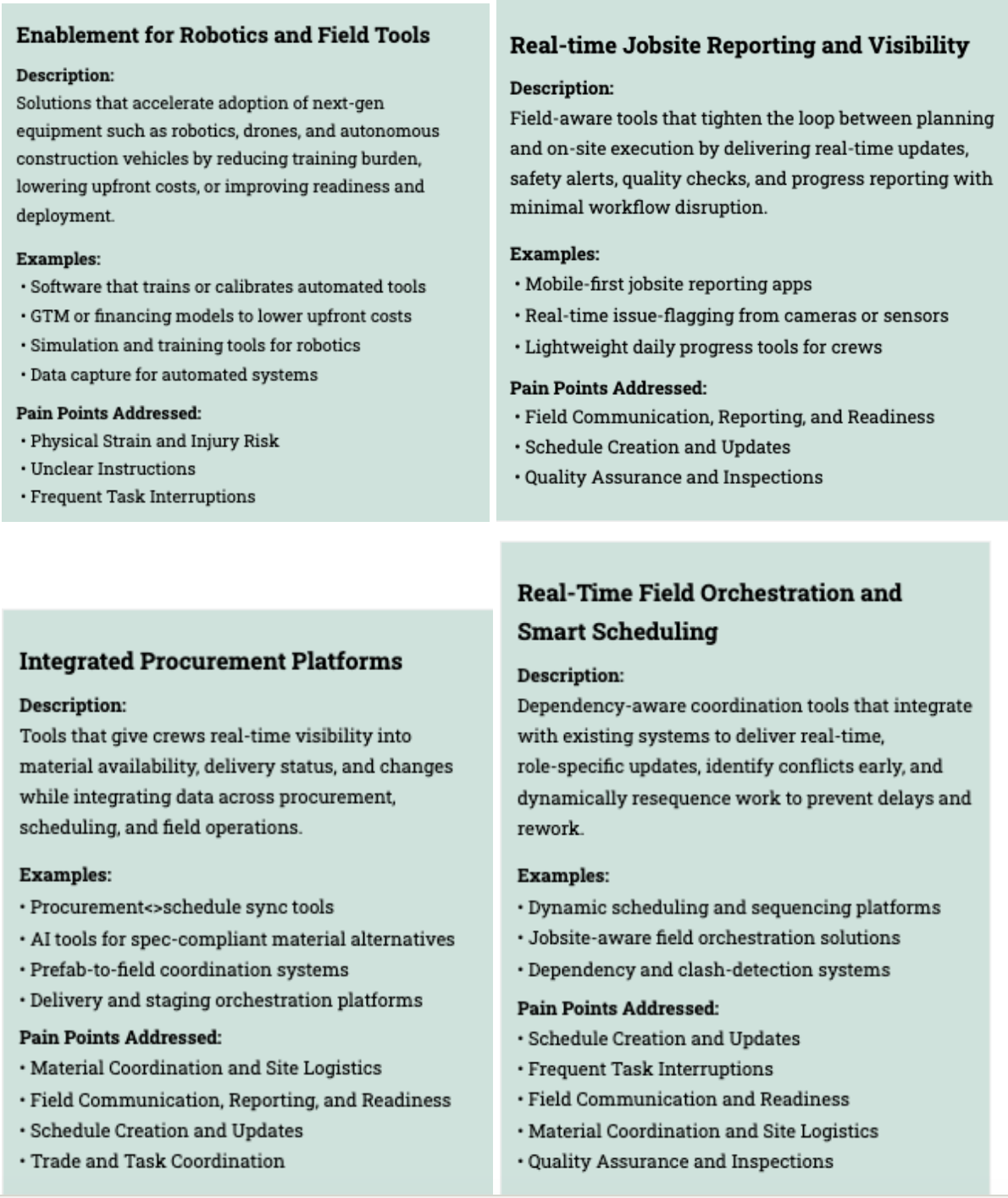
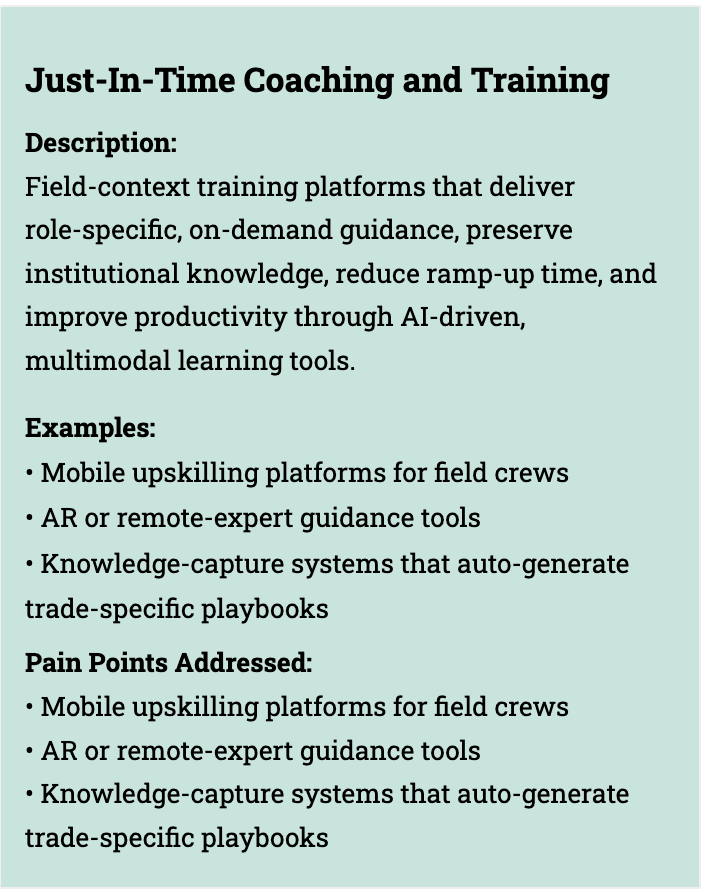
These five opportunities reflect the types of solutions we find most compelling, but our lens will consistently focus on a product’s ability to both support the worker directly and address the systemic issues inherent to the sequential, interdependent nature of construction. With this approach, we aim to surface opportunities that have the potential to lift construction’s multi-decade-long, nearly stagnant productivity growth rate.
V. Conclusion
Construction projects are an amalgamation of interdependent workflows involving multiple stakeholders, and the solutions with the greatest potential will be those that understand that system context and are designed to support the workflows that define field execution.
The industry now sits at a moment where technologies are uniquely able to address challenges that span the field and the back office. Field-ready AI cameras can now process data on the edge to understand jobsite conditions in real time, and AI models can use other point solution data to contextualize the information. AI agents built for specific workflows can then collaborate to update schedules, notify the right teams, and trigger downstream tasks that today depend on manual coordination. It is the moment for founders to build solutions that meet the realities of the field, and for construction leaders to embrace innovation that can meaningfully move the industry forward.
Appendix
Detailed Descriptions of Five Opportunity Areas
1. Enablement Layer for Robotics and Advanced Field Tools
Description:
To directly support the effectiveness of workers as they carry out their primary tasks, there is a need to develop physical tools that ensure both worker productivity and safety. Construction has seen meaningful innovation in hardware such as robotics, drones, automated vehicles, and advanced tools, and these technologies have the potential to reshape the industry.
Because our investment approach prioritizes asset-light opportunities, we focus on solutions that enable the development, deployment, and adoption of these tools. The goal is to increase readiness, improve deployment velocity, and make next-generation equipment usable by the workforce in real field conditions.
Examples:
• Software that trains or calibrates automated tools
• Go-to-market or financing models such as Robots-as-a-Service that lower upfront costs
• Simulation and training tools for robotic usage/maintenance
• Data-capture systems that feed automated or semi-automated equipment
Pain Points Addressed:
• Physical strain and injury risk
• Unclear instructions
• Frequent task interruptions
2. Real-Time Jobsite Reporting and Visibility
Description:
There is a clear gap between planning and scheduling decisions and what is happening on the jobsite. This creates constant delays in the feedback loop between field conditions and project leadership. Opportunities exist for solutions that are fieldworker-aware and eliminate friction for workers who are moving across the site focused on task execution.
Examples of valuable capabilities include alerting platforms that surface safety or quality issues, provide real-time progress visibility, or automate reporting with minimal user input.AI-native systems that understand unstructured data (video, images, voice notes) and can process information on the edge unlock completely new forms of site awareness. We are particularly interested in solutions that integrate across scheduling, safety, and reporting systems, provide multilingual interfaces, and deliver value across multiple workflows rather than serving as isolated reporting utilities.
Examples:
• Hands-free reporting tools (mobile, voice & vision, wearables) to ease reporting
• AI-enabled site observation systems (cameras & sensors) for safety, progress, or design v. build divergence
• Lightweight daily progress tools for crews
Pain Points Addressed:
• Field communication, reporting, and readiness
• Schedule creation and updates
• Quality assurance and inspections
3. Integrated Procurement Platforms
Description:
Crews are often idle because the materials they need to perform their work are not available when they need them. Causes include long lead times, outdated information, change orders, scheduling adjustments, and sequencing issues. There is a need for platforms that consolidate the required inputs for procurement decisions and disseminate consistent, real-time material readiness information to field teams.
These systems should help stakeholders understand tradeoffs related to cost, schedule, environmental impact, and labor efficiency while providing interoperability across disparate procurement systems, scheduling systems, and communication channels.
AI-native solutions are particularly well suited to this problem because they can interpret unstructured data (emails, PDFs, photos of packing slips, jobsite videos), reconcile it with structured procurement and scheduling data, and surface material risks earlier than traditional rule-based systems. AI agents can also propagate procurement changes across schedules, budgets, and field workflows automatically, ensuring downstream stakeholders stay aligned without manual coordination.
Examples:
• Procurement-to-schedule synchronization tools
• AI tools for spec-compliant material alternatives
• Prefabrication-to-field coordination systems
• Delivery and staging orchestration platforms
Pain Points Addressed:
• Material coordination and site logistics
• Field communication, reporting, and readiness
• Schedule creation and updates
• Trade and task coordination
4. Real-Time Field Orchestration and Smart Scheduling
Description:
Field supervisors spend a disproportionate amount of time tracking progress, resolving blockers, relaying updates, and adjusting short-interval plans. As a result, schedules remain static while site conditions evolve rapidly. There is a need for real-time orchestration systems that continuously sense what is happening on the jobsite and automatically update or recommend adjustments to the plan based on changing conditions.
Vision models and streaming-perception are improving at a rapid pace (eg: Twelve Labs, NVIDIA, DeepMind) . Modern models no longer just detect objects in static images, they can interpret motion, sequencing, and workflow progress across time, enabling automatic detection of stalled work, blocked access paths, or out-of-sequence installation. Breakthroughs in edge inference (e.g., Jetson Orin devices, Qualcomm’s RB5 platform) now allow cameras to process this information on-device with low latency, even in low-connectivity environments.
We expect the next generation of field orchestration to be AI-native, with agents capable of extending jobsite coordination well beyond what a single supervisor can manage today.
Examples:
• AI-native dynamic scheduling and sequencing platforms
• Jobsite-aware field orchestration tools
• Automated dependency & constraint detection systems
Pain Points Addressed:
• Schedule creation and updates
• Frequent task interruptions
• Field communication and readiness
• Material coordination and logistics
• Quality assurance and inspections
5. Just-in-Time Coaching and Training Solutions
Description:
With a large portion of the skilled workforce retiring and new workers entering with shorter tenure, there is significant opportunity for tools that compress ramp-up time while preserving institutional knowledge.
Next-generation training platforms should deliver just-in-time, role-specific guidance at the point of work. Multimodal AI tools such as voice and vision interfaces, AR or VR systems, and remote expert guidance can play meaningful roles if designed for actual jobsite conditions.
We are interested in solutions that blend dynamic content generation with field-context awareness, enabling workers to receive step-by-step instructions, safety prompts, or troubleshooting support grounded in the real environment. An ideal platform would include metric-driven impact measurement to better quantify ROI.
Examples:
• Mobile upskilling platforms designed for field crews
• AR or VR systems for remote expert guidance
• Knowledge-capture tools that automatically generate trade-specific playbooks
Pain Points Addressed:
• Poor communication and unclear instructions
• Frequent task interruptions
Process & Methodology
We grounded this research in direct observations of field workflows and the roles that support jobsite execution. Our process combined role-mapping, workflow analysis, and interviews with construction professionals across multiple trades, project types, and organizational structures. We began by mapping roles across the full construction lifecycle to understand how work is planned, coordinated, and executed. From this broader value-chain view, we identified 15 roles with influence on field execution and then narrowed our focus to the subset with the greatest direct impact, including frontline craft workers. These roles formed the basis for our interviews and workflow analysis. We began with a ground-up role mapping exercise to understand where craft execution most often breaks down. This started with a broad, 15-role taxonomy spanning the full construction lifecycle, from Pre-Construction to Construction to Post-Construction. Using these inputs, we synthesized recurring pain points across planning, coordination, and execution activities. This analysis produced the core findings outlined in the next section, as well as the opportunity areas highlighted later in the report.
Firms Interviewed:
- DPR Construction
- DivcoWest
- Webcor
- Gray Civil
- Opus


