
 Download Here
Emerging Opportunities Across Grid Technology
September 2026
Market Trends and Investment Themes
The grid is shifting toward a more dynamic, software-enabled system, creating a broad and fast-growing set of opportunities across the segments profiled in this brief. |
Why now Rising demand (AI, data centers, electrification), aging infrastructure, and affordability constraints are forcing utilities to adopt new technology rather than rely solely on costly physical buildout. | Key opportunity areas Five priority areas: storage, large-load flexibility, dynamic line ratings, interconnection compliance, and weather resilience. Whitespace: queue automation, AI-native compliance. | Evaluating moats Startups in this space can be scored against a six-part moat framework: physical, technical, data, workflow, customer, and economic defensibility. |
This market is large, fragmented, and maturing fast. The companies that win will pair proprietary data with embedded workflows and provable ROI. |
The Grid’s Recent Changes
The electricity grid is undergoing a structural transition. What was once a largely one-way system built around centralized generation is becoming a more dynamic, bidirectional network, with software, storage, flexible loads, and distributed resources playing a growing role.
Three shifts are driving the change. Demand is increasing, driven by data centers, AI infrastructure, manufacturing, and electrification after two decades of relatively flat U.S. electricity consumption. Reliability is becoming harder to manage, as utilities balance aging infrastructure, extreme weather, increasingly complex load profiles, and long interconnection queues. And affordability remains a constraint, as utilities and regulators look for ways to fund new infrastructure without pushing costs disproportionately onto residential customers.
Regulation is changing alongside the market. Policymakers are focused on speeding up interconnection, making better use of existing transmission, and determining who should pay for new infrastructure. At the same time, some states are reconsidering how new data centers connect to the grid as they work through the implications of rapid large-load growth.
The grid needs to become more flexible, more observable, and more efficient without every solution requiring massive new infrastructure buildouts. |
Mapping the Grid Tech Landscape and Whitespace
The grid technology landscape spans four broad areas: Grid Infrastructure & Buildout, Grid Management Software, Monitoring & Modeling, and Regulatory & Compliance.
Across these categories, the most interesting companies tend to share a few characteristics. Hardware can create a strong moat when it improves the physical grid while also generating proprietary operating data. Software is most compelling when it becomes part of a utility's actual workflow, rather than simply adding another analytics dashboard.
There is also a meaningful advantage to understanding how utilities buy and operate technology. The market is fragmented, highly regulated, and slow-moving in some areas. Products that require major changes in behavior can struggle, even when the underlying technology is strong.
The best opportunities tend to sit at the intersection of mission-critical workflows, proprietary data, and measurable economic value.
Utilities have little tolerance for products that fail in the field. But adoption can move quickly when a product can demonstrate that it improves reliability, delays a major capital project, speeds up interconnection, or lowers operating costs.
Two areas stand out as particularly interesting whitespace today: interconnection queue automation and AI-native NERC/FERC compliance.
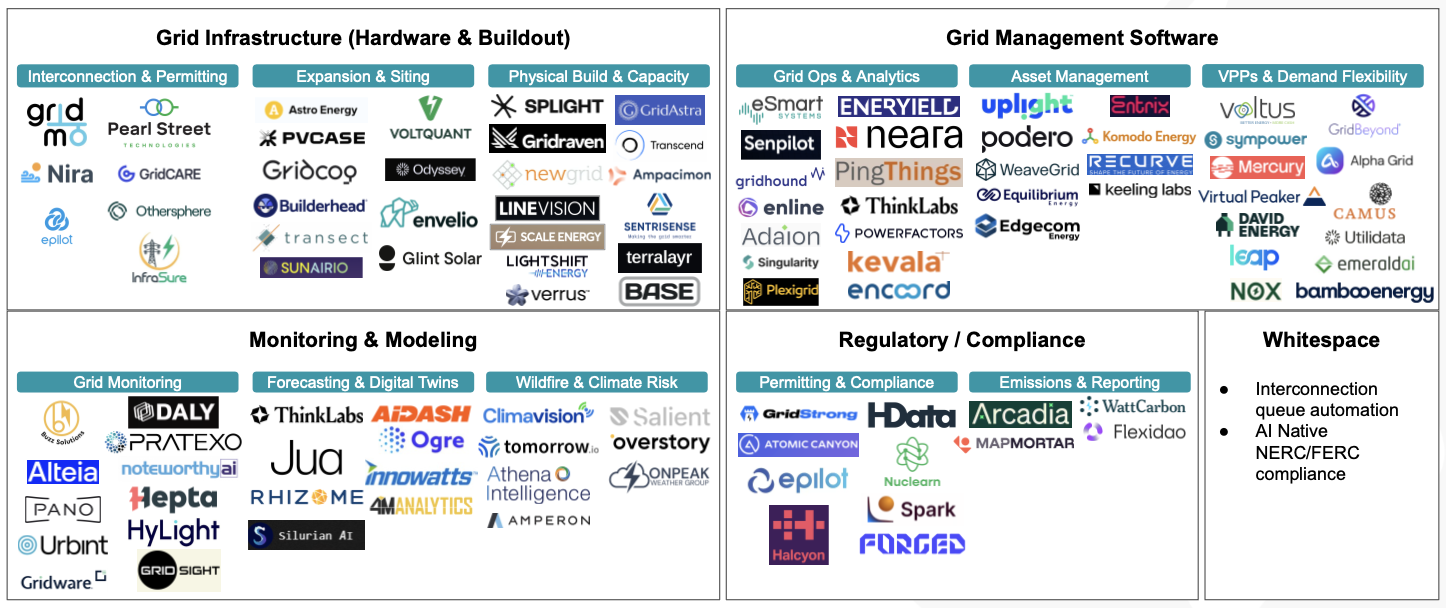
Note: the company landscape referenced is a non-exhaustive list.
Five Themes Shaping Grid Tech Investment
1 | 2 | 3 | 4 | 5 | ||||
Storage & Flexibility as a Service Scalable, modular storage systems and business models that stabilize local distribution network fluctuations. | Large-Load Flexibility Software and demand-response platforms optimizing commercial, industrial, and AI data center energy consumption. | Dynamic Line Ratings (DLR) Advanced sensors and analytics to safely increase existing line capacity and maximize transmission efficiency. | Interconnection & Regulatory Compliance Digital tools that streamline compliance, speed up queue times, and reroute power around congestion. | Weather Forecasting & Grid Resilience Predictive software and AI models helping utilities adapt to severe weather and optimize energy assets. |
Soaring power demand, infrastructure bottlenecks, and extreme weather events are creating an urgent need for utilities and energy consumers to innovate, driving strong willingness to pay across the space and making these segments attractive spaces for investment, now. |
Sizing the Opportunity Across Key Segments
Segment | Market | Opportunity |
Weather Forecasting & Grid Resilience | $3.1B → $4.9B 7.0% CAGR (2026–2033) | Localized forecasting and resilience planning are becoming more important as weather and grid conditions grow more variable. The opportunity is moving toward proprietary models, asset-level intelligence, and tools that translate forecasts into operational decisions. |
Large-Load Flexibility | $4.56B → $13.24B 15.7% CAGR (2026–2033) | Data centers and other large loads are creating new constraints for utilities. Technology that makes these loads more flexible could help manage capacity, improve reliability, and defer infrastructure investment. The market is still early, leaving room for new entrants with strong proof points. |
Dynamic Line Ratings | $1.8B → $5.6B 13.4% CAGR (2025–2034) | Transmission capacity is increasingly constrained, while building new lines can take years. Dynamic line ratings increase utilization of existing infrastructure using real-time conditions rather than conservative static assumptions. |
Interconnection & Regulatory Compliance | $4.33B → $10.6B 13.6% CAGR (2026–2033) | Interconnection has become a major bottleneck for new generation and large loads. Software that reduces friction around applications, studies, documentation, and compliance can address a highly manual, fragmented process. |
Storage & Flexibility as a Service | $2.2B → $3.3B 11.0% CAGR (2026–2030) | Demand for flexible capacity is growing as load becomes more dynamic and renewable penetration increases. Business models depending on project finance and physical deployment carry more execution risk; software that improves economics and utilization of deployed assets is particularly interesting. |
* Note: figures below reflect different forecast windows (ranging from 2025–2034 to 2026–2033) and are not directly additive.
These categories differ meaningfully in maturity, but the underlying opportunity is similar. The grid has become more constrained, more complex, and more data driven, creating opportunities for companies that make existing infrastructure work harder, help utilities manage new demand, or reduce friction in deploying and operating assets.
Sources: Storage as a Service Market, Demand Response Market, Dynamic Line Ratings Market, North America Smart Grid Market, Interconnection Queue Analytics Market, Weather Forecasting Services Market
A Framework for Evaluating Startup Defensibility
Grid technology is a different kind of market from traditional software. Customers are highly regulated, systems are mission-critical, and procurement cycles can stretch for years.
When evaluating companies in the space, we look at six sources of defensibility:
|
|
| |||||
|
|
| |||||
The strongest companies will likely combine several of these advantages. A product deeply embedded in a utility workflow is more valuable when it also produces proprietary data. Hardware becomes more defensible when it creates a software or data layer, and customer relationships matter more when the product has a long track record of improving reliability or reducing costs.
The key question is not simply whether a company is selling into the grid, it is whether it is solving a problem that is becoming more important, in a way that gets harder to replicate as the company scales.
What's Next
The grid creates an unusually broad set of opportunities because constraints are emerging across generation, transmission, distribution, and load at the same time.
Near-term opportunities are particularly compelling where technology can unlock existing infrastructure rather than wait for new infrastructure to be built including better forecasting, increased transmission utilization, load flexibility, and software that reduces interconnection and compliance friction.
Adjacent areas worth watching include grid cybersecurity, battery intelligence software, DER and VPP orchestration, transmission permitting, nuclear and SMR-adjacent grid integration, and behind-the-meter power for hyperscale customers.
The common thread isn't any single technology. It's where the grid is becoming constrained and where software, data, or new infrastructure can create measurable economic value. |
Interested in this space or evaluating startups here? We'd love to connect. |


