
 Download Here
Building the Workflow Intelligence Layer for Enterprise AI: Our Investment in Canyon Code
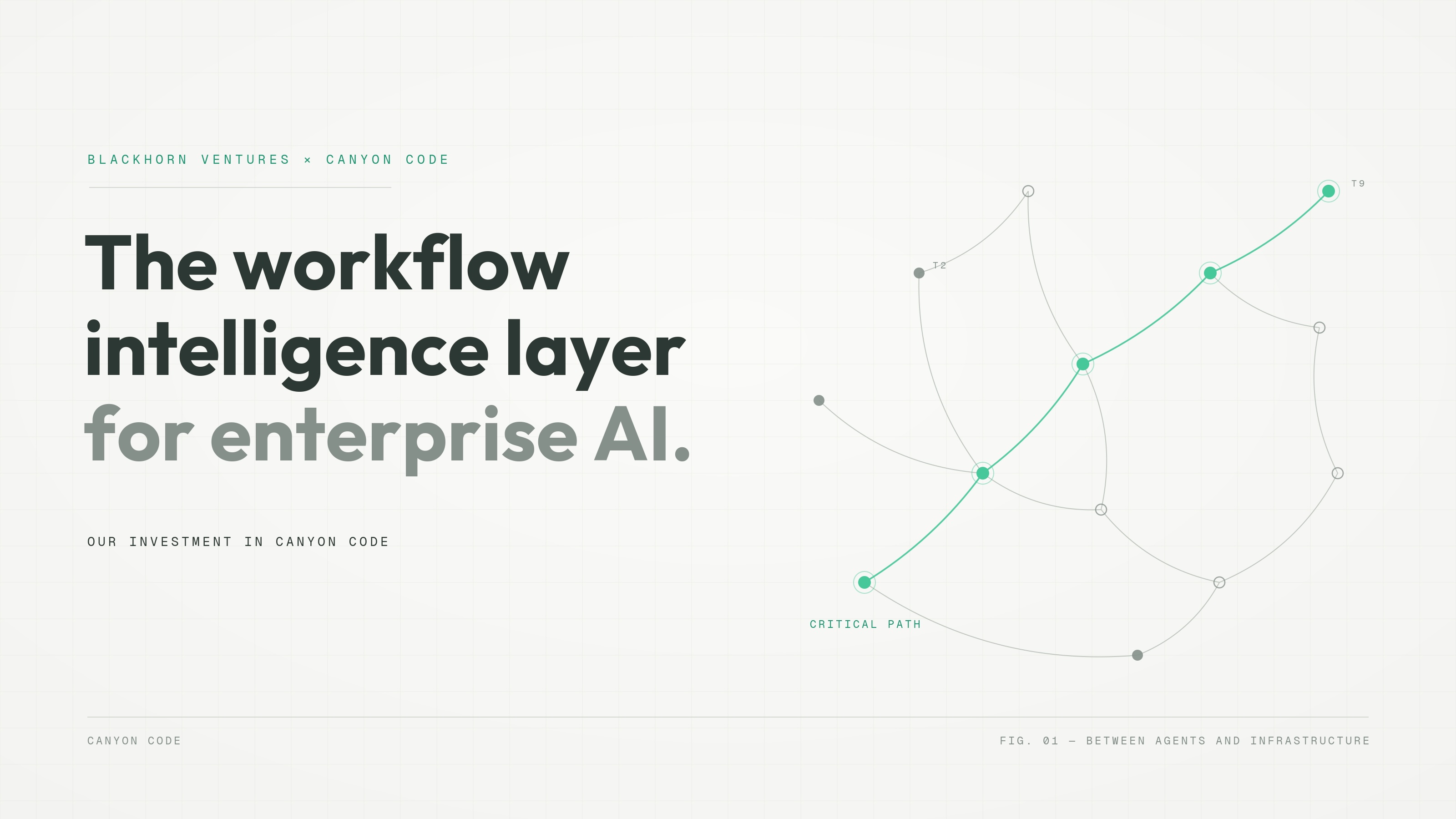
Blackhorn Ventures is proud to announce our participation in Canyon Code's $5M pre-seed round, led by Cota Capital with participation from Newbuild Ventures. Canyon Code is building the workflow intelligence layer for enterprise AI, the missing layer between how models serve tokens and how enterprises actually need outcomes delivered.
The Problem
Companies across the Fortune 500 and beyond are crossing the threshold from AI experimentation into multi-agent production deployments. The infrastructure underneath them was never designed for it. Meanwhile, the popular discourse around AI has shifted from concerns about demand to worries about supply to a full-on freakout over value. The costs of automated intelligence are here to stay (and they’re getting more expensive over time).
Today's model-serving systems, vLLM, Triton, Kubernetes, Run:AI were built to optimize for a single objective: making individual token generation cheaper and faster. That is the wrong optimization target for real-world AI and does not help solve for the elusive ‘compute-to-labor ratio’. In production, agents do not operate in isolation. They hand off work, wait on upstream outputs, branch on runtime conditions, retry, and converge. Today’s infrastructure has no visibility into how agents are executing.
The result is a system optimized for the wrong unit of compute, and token usage is becoming unbundled from enterprise productivity:
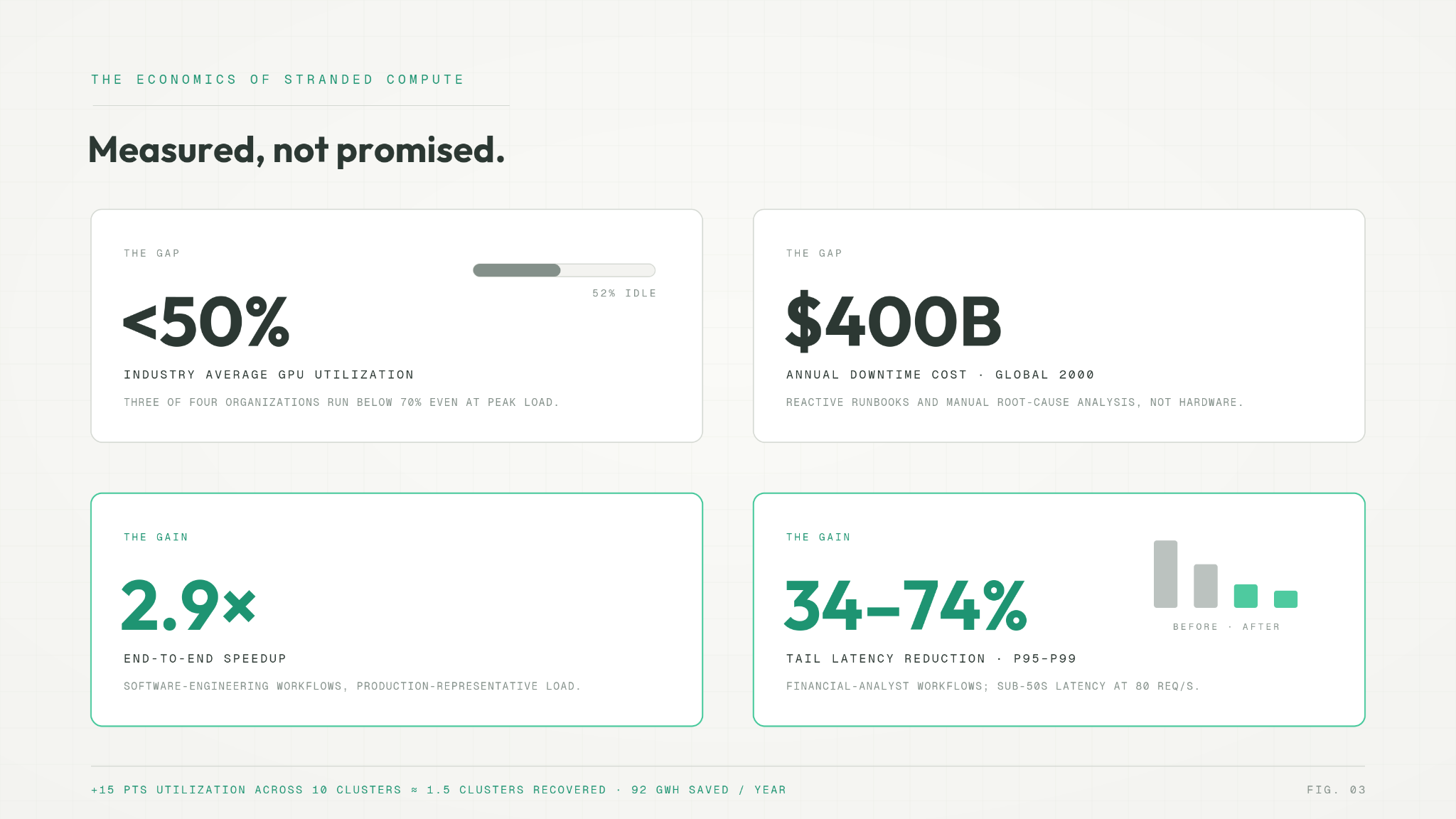
- Industry average GPU utilization sits below 50%. Three out of four organizations run below 70% even at peak load.
- 10–15% of GPUs are down at any given time. In a 10,000-GPU cluster, a single failure cascades to 4–8 additional GPUs and costs 5–6 hours of lost compute, roughly $25M in revenue loss per cluster per year.
- Downtime costs Global 2000 companies an estimated $400B annually — not because the hardware is unreliable, but because operations teams are managing it with reactive runbooks and manual root cause analysis.
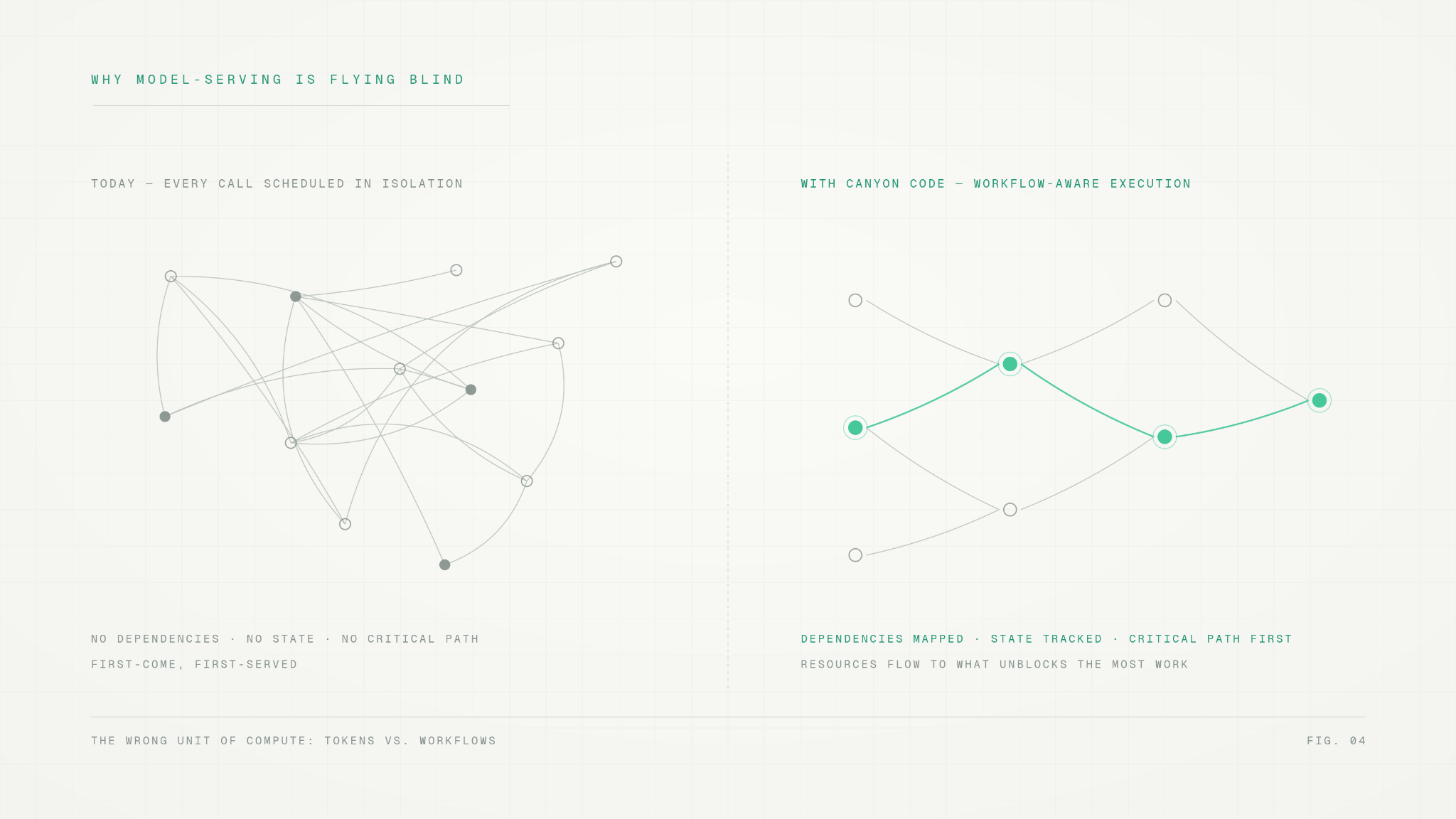
These are not hardware problems. They are orchestration and visibility problems. The infrastructure is flying blind across multi-agent workflows, scheduling each model call as if it exists in isolation, with no awareness of dependencies, state, or what is the critical path.
The Solution
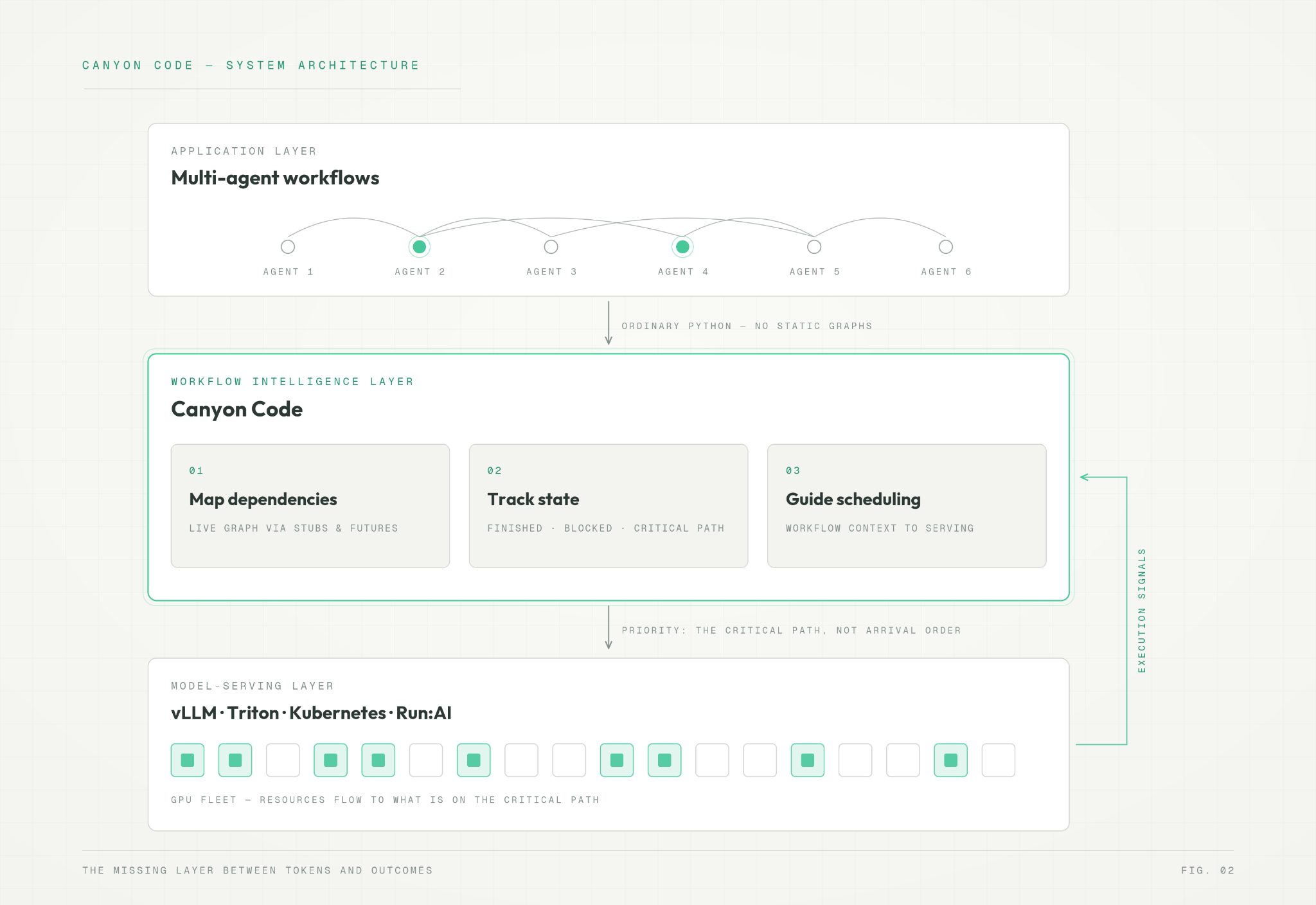
Canyon Code is building the Workflow Intelligence Layer, which sits between the application layer and the model-serving layer. It does three things that no existing system does:
1. Maps how agents depend on one another.
In real-world AI systems, agents hand work off, wait on other agents, branch, retry, and converge. Canyon Code's core innovation, built on academic research, uses a stubs and futures mechanism to instrument these dependencies in real time. Developers write ordinary Python; the system builds a live dependency graph underneath, without requiring static workflow declarations upfront.
2. Tracks the state of each agent and the overall workflow.
The system knows what has finished, what is blocked, what is waiting, what is redundant, and what is on the critical path, continuously, across the full workload.
3. Guides the model-serving layer accordingly.
Instead of infrastructure making scheduling decisions with only a local view of token demand, Canyon Code feeds full workflow context back into the serving layer. If one agent's output is a prerequisite for three others, it gets prioritized. Resources flow to what is actually on the critical path, not to what arrived first.
The performance benchmarks are compelling: up to 2.9x end-to-end speedup on software engineering workflows, 34–74% reduction in tail latency (P95–P99) on financial analyst workflows, and sustained sub-50-second average latency at 80 requests per second, load levels where Ray-based baselines fail entirely. A single neo-cloud operator improving utilization from 50% to 65% across 10 clusters would recover the equivalent of 1.5 new clusters of capacity and save approximately 92 GWh of energy per year.
Why We Invested
At Blackhorn, we back companies building the operational infrastructure that makes physical and industrial AI work at scale, not the models or novel chips, but the systems that make models deployable, reliable, and economically rational.
Canyon Code fits squarely into our thesis around AI compute efficiency, labor augmentation, and enabling distributed enterprise deployment.
Three key assumptions drove our investment decision:
The problem is structural, not cyclical. The gap between how model-serving infrastructure was designed and what enterprise multi-agent workflows actually need is architectural. It cannot be patched by tuning existing schedulers. The same complexity growth, 10–15x in agentic workload complexity over recent years, that makes the problem urgent also makes it durable.
The moat is real. The futures and stubs mechanism at the core of it is not a feature that can be bolted onto existing systems. It requires a ground-up redesign of how the runtime tracks and manages workflow state. Existing solutions force a false choice: declare static graphs upfront and lose flexibility, or treat agents as black boxes and lose visibility. Canyon Code resolves that tradeoff. The benchmarks validate the architecture in production-representative conditions. Hardware OEMs will differentially benefit from their solution, providing a path for a vendor-agnostic solution.
Enterprise validation is already in motion. Canyon Code has signed POCs with tier-1 Telcos. VP and CTO-level inbounds from Nokia, eBay, and Apple confirm the problem is felt at the top of the stack. When the VP of Infrastructure at Nokia says "we've been looking for a solution like this," and the VP of Engineering at eBay says he's "getting angry calls from his CTO about this," that's a buying signal, not a research conversation.
The market opportunity is substantial: neo-cloud operators represent a TAM exceeding $23B, enterprise verticals add another $13B+, and sovereign AI programs are emerging as a fast-growing category. At ~10% value capture on recovered compute economics, a small number of enterprise wins translate quickly into meaningful revenue.
The Team
We were introduced to Canyon Code CEO and co-founder Ravikiran (Ravi) Gopalan by Blackhorn Operating Partner Jack Fuchs. Jack and Ravi have a long history of collaboration from their time together at Stanford University, and Jack has mentored Ravi as a three-time founder with deep roots in AI infrastructure. Ravi previously co-founded and served as CTO of Aira Technologies, where he re-imagined wireless system design using data-driven approaches, and earlier built Acuity.AI (an ML-focused company exploring intelligent applications of rich media) out of Stanford Graduate School of Business. He discovered the GPU utilization problem firsthand while deploying multi-agent systems into large enterprises and recognized it as architectural, not operational.
His co-founder and Chief Scientist is Aditya Akella, Regents Chair Professor of Computer Science at UT Austin and a Research Scientist at Meta. Aditya is one of the most recognized systems researchers in the world (ACM Fellow, SIGCOMM Test of Time Award, Blavatnik National Award finalist) with decades of work at the intersection of operating systems, networking, and machine learning. He leads the NSF CISE Expedition on Learning-Directed Operating Systems and directs InfraAI @ UT, and is the co-author of foundational GPU scheduling work, including Themis (NSDI 2020) and Shockwave (NSDI 2023). The research at the core of Canyon Code’s technology is his lab's work, now making the transition from academic prototype (~13,300 lines of working Python) to production product.
The combination of a multi-time founder who knows the enterprise sales motion and a world-class systems researcher who built the underlying architecture is exactly the pairing this problem requires.
How We'll Help
Blackhorn brings a specific set of capabilities that map directly to Canyon Code's next set of milestones:
Customer introductions. We’ll open doors into hyperscalers, neo-cloud operators, and enterprise infrastructure teams through our portfolio and LP relationships. Our network in telco, an early and high-signal vertical for Canyon Code, is particularly relevant, as is our relationship with large enterprises running hybrid AI deployments.
Commercial strategy. Canyon Code's compute-linked pricing model — capturing ~10% of recovered value — is elegant but requires sophisticated buyers who can validate ROI. We’ll help the team refine their enterprise sales playbook, recruit a senior commercial lead, and navigate the 6–12 month enterprise procurement cycles they will face.
Strategic positioning. Canyon Code's energy efficiency angle, recovering stranded compute rather than building more of it, is a genuine differentiator with ESG-conscious infrastructure buyers and sovereign AI programs. We will help sharpen that narrative and connect the team with capital and strategic partners who think in those terms.
Silicon and ecosystem partnerships. Canyon Code's vendor-agnostic architecture is a strategic asset as AMD, Intel Gaudi, and custom AI accelerators gain share. We’ll support partnership discussions with silicon vendors and ensure Canyon Code is positioned as the orchestration layer of choice across heterogeneous hardware environments.
We’re looking forward to working alongside Ravi, Aditya, and the Canyon Code team as they move from validated research to production deployments and build the workflow intelligence layer that enterprise AI has been missing.
Read more about Canyon Code's $5M pre-seed announcement on
.


