
 Download Here
Building AI for the World's Least-Digitized Industry:
Paul Zeckser, CEO of LightTable on Reinventing Construction Quality Assurance
Walk into any hospital, airport, office building, or apartment complex and it's easy to admire the finished product. What's far less visible is the extraordinary amount of coordination required before a single shovel ever hits the ground.
Behind every building is a complex network of architects, structural engineers, mechanical engineers, contractors, and specialty trades working across thousands of pages of drawings. Despite the size and sophistication of the construction industry
(Expert Market Research pegs the construction market at 14.45 trillion USD in 2025, roughly 13–15% of global GDP today, with a projected 27.12 trillion USD size by 2035, CAGR ~6.5%) much of this coordination still relies on workflows that haven't fundamentally changed in decades. Teams manually compare drawings, reconcile conflicting plans, and hunt for design issues long before construction begins, a process that is both time-consuming and prone to human error.
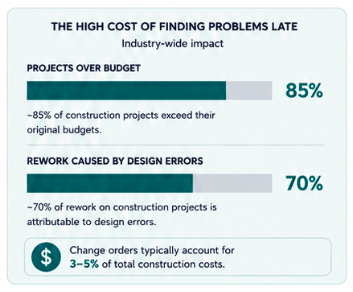
Construction is an industry where mistakes compound quickly. Roughly 85% of projects exceed their original budgets, and design-related rework remains one of the industry's largest sources of wasted time and cost. Some studies estimate that design issues account for more than 70% of construction rework.
For Paul Zeckser, CEO and co-founder of Lighttable, the problem felt strangely familiar.
After more than fifteen years building consumer and enterprise software products, he'd spent countless release cycles watching engineering teams manually test applications before shipping. Software solved that problem years ago through automated testing.
Construction never did.
We sat down with Paul to discuss how Lighttable is bringing AI-powered quality assurance to the architecture, engineering, and construction (AEC) industry, why vertical AI wins over general-purpose models, and how he envisions technology making construction professionals more capable—not obsolete.
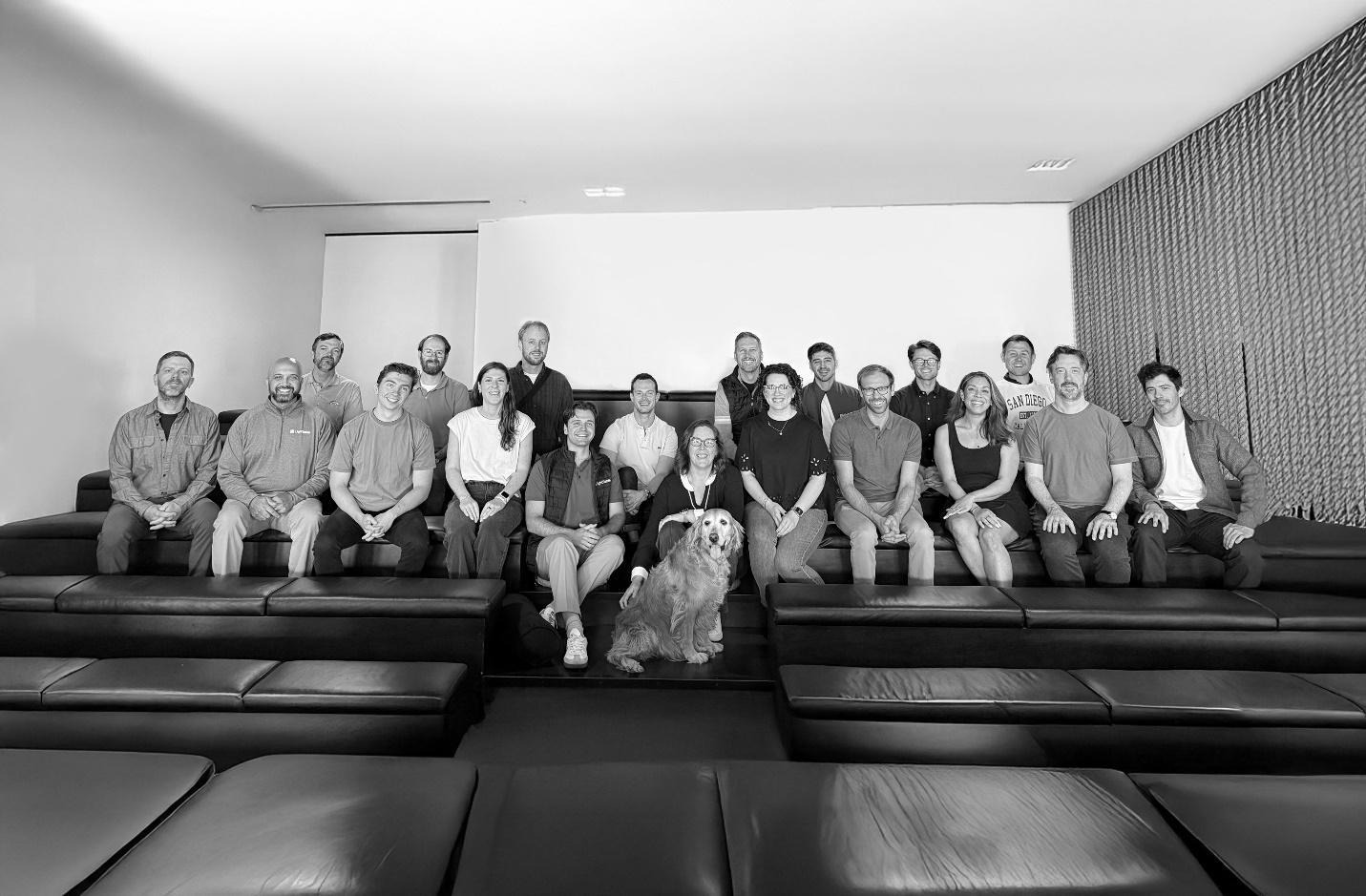
(The LightTable team)
Software Solved QA Years Ago. Construction Never Did.
"I kept seeing the same movie over and over again," Paul recalls.
Throughout his career leading product teams, every release ended the same way: manual quality assurance. Teams clicked through every workflow, trying to identify bugs before customers found them first.
Eventually, software engineering evolved. Automated testing became standard practice.
Then Paul met his future co-founder, Ben Waters, a Cornell-trained architect who had spent years at firms including SOM and Gensler.
As Ben described the design review process in architecture, Paul couldn't believe how familiar it sounded.
Teams were still reviewing drawing sets page by page. Creating overlays manually. Comparing structural drawings against architectural plans by hand. Spending weeks trying to catch coordination issues before projects went out to bid.
"It immediately reminded me of software QA before automation."
The final piece of the founding team came with Dan Becker, one of the world's leading practitioners in applied AI. Before joining Lighttable, Dan served as Head of Kaggle Learn at Google, helping educate millions of aspiring machine learning practitioners, and later led AI development tools at DataRobot following the acquisition of his startup, Decision.ai. He is also one of the top-ranked competitors in Kaggle's global machine learning community, earning Kaggle Notebooks Grandmaster status and placing second out of more than 1,300 teams in the Heritage Health Prize competition.
Each founder brought something uniquely valuable to the company. Ben had spent years living the pain inside architecture firms. Paul had experienced firsthand how software transformed quality assurance through automation. And Dan brought world-class AI expertise that could finally make the same transformation possible for construction. Together, they saw an opportunity to modernize one of the industry's oldest and most expensive workflows.
The Hidden Cost of Manual Design Review
For decades, manual quality assurance wasn't simply inefficient, it was unavoidable.
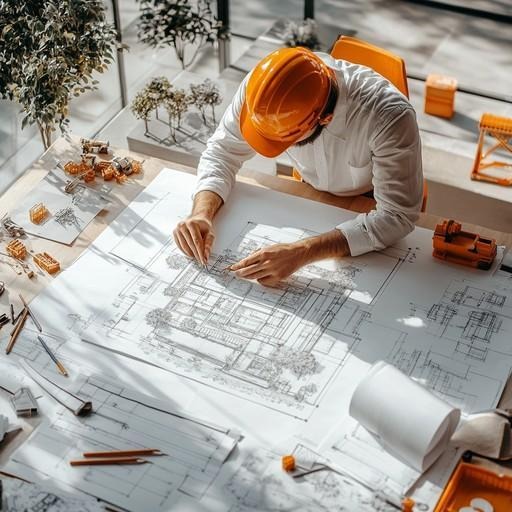
Large commercial projects routinely contain hundreds, sometimes thousands, of pages of architectural, structural, mechanical, electrical, and plumbing drawings. Every discipline affects the others, meaning even a small design change can create downstream conflicts that remain hidden until construction begins.
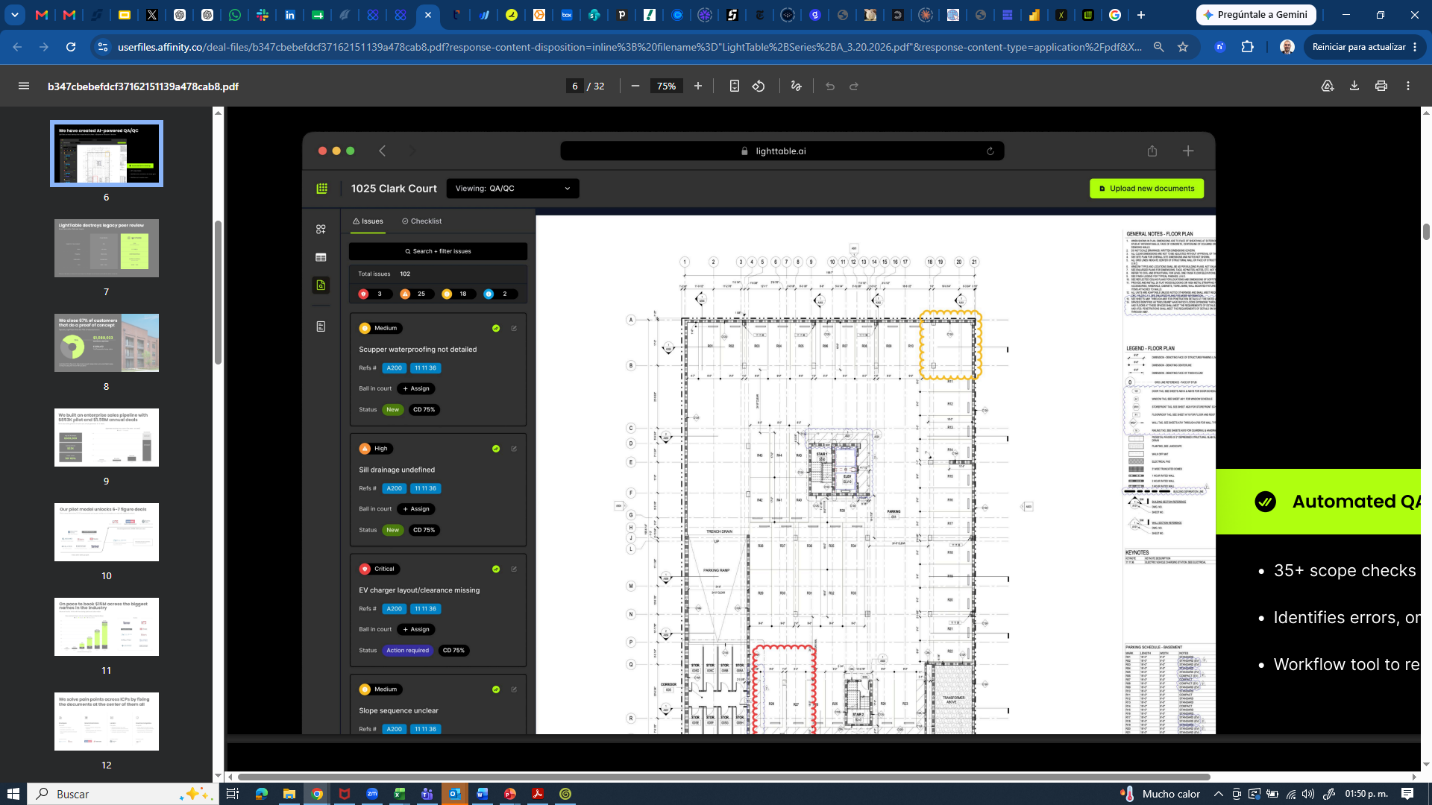
Traditionally, reviewing an 800-page drawing package could occupy teams for three to four weeks. Lighttable completes that review in roughly three to five hours. More importantly, it isn't simply reading documents faster. The platform analyzes relationships across disciplines, automatically generating overlays while identifying coordination conflicts, omissions, constructability risks, and value engineering opportunities before they become expensive change orders.
The economic impact is substantial. Industry-wide, peer review often costs between $50,000 and $100,000 per project while still catching only a fraction of the issues that ultimately become field change orders.
For owners, contractors, and design firms, finding problems before construction begins is dramatically less expensive than fixing them after concrete has been poured.
Why Domain-Specific AI Beats General AI
With powerful foundation models now available to everyone, it's reasonable to ask whether a general-purpose AI model could perform this work. Paul and his team decided to test it.
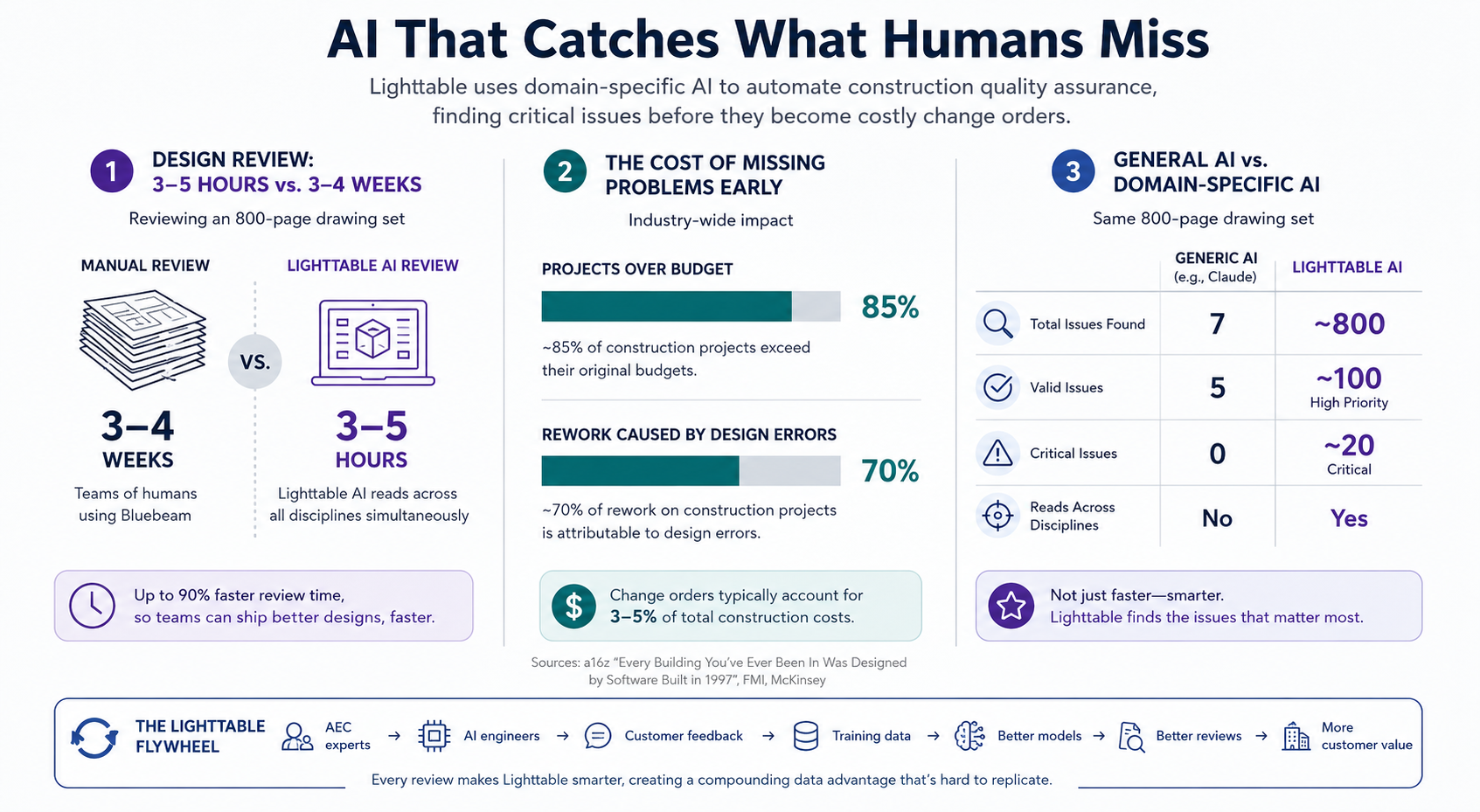
They uploaded the same drawing package into a leading frontier model. The model identified seven potential issues. Five were legitimate observations.
Then they ran the exact same project through Lighttable. The result was dramatically different: Lighttable identified roughly 800 findings, including approximately 100 high-priority issues and around 20 critical problems requiring immediate attention. None of the issues surfaced by the general-purpose model fell into the critical category.
"The difference isn't simply using AI," Paul explains. "It's understanding construction."
Construction quality assurance isn't about reading one drawing at a time. It requires simultaneously understanding architectural, structural, mechanical, electrical, and plumbing systems while reasoning across hundreds of interconnected documents.
That's a fundamentally different problem than document summarization.
The Competitive Advantage Isn't Just AI, It's the Feedback Loop
While many AI startups focus primarily on larger models, Paul believes Lighttable's real advantage comes from something much harder to replicate. Building world-class vertical AI requires more than powerful foundation models. It requires deep domain expertise, proprietary workflows, and exceptional AI talent. With seasoned architects and engineers working alongside one of the world's leading applied AI practitioners, Lighttable has built an unusually tight feedback loop between construction expertise and machine learning research. Construction experts push the limits of the models. Engineering teams immediately iterate. Every customer interaction creates new training data, continuously improving the system over time.
The result is a continuously improving system rooted in actual construction expertise rather than generic internet knowledge.
It's also one reason investors increasingly see AI-native construction software as an opportunity to build around, not replace, the industry's entrenched design tools. Instead of asking firms to abandon decades of existing workflows, companies like Lighttable automate the high-value work surrounding them while improving with every completed project.
Construction Doesn't Resist Technology. It Resists Risk and Bad ROI.
Construction is often portrayed as slow to adopt new technology. Paul disagrees.
"In our experience, construction companies adopt technology surprisingly quickly, when the value is obvious."
The industry's skepticism isn't toward software itself. It's toward software that promises transformation without delivering measurable improvements.
"If a tool doesn't improve quality, reduce costs, or accelerate schedules, people won't use it."
When ROI is clear, adoption happens much faster than outsiders often assume. That philosophy extends beyond product development.
Lighttable operates with a highly relationship-driven approach, spending time on customer job sites, learning individual workflows, and building long-term partnerships rather than transactional software sales.
There Are No Shortcuts
After more than two decades building technology companies, one lesson surprised Paul during his journey building Lighttable:
"I thought experience would unlock some efficiency hack."
It didn't.
Whether you've been building companies for five months or twenty-five years, startups still require relentless persistence.
"There isn't a shortcut. You simply have to give it everything."
One practice that has proven invaluable has been cultivating a network of trusted advisors. As a first-time CEO, Paul intentionally created space to regularly meet with experienced founders, operators, and investors, sometimes formally, sometimes simply over coffee.
"The startup community is remarkably generous. If you're willing to ask questions and be honest about what you're struggling with, people genuinely want to help."
AI Should Make Experts Better
Much of today's conversation around artificial intelligence centers on replacement. Paul sees something very different.
He doesn't envision architects, engineers or construction professionals disappearing.
He envisions repetitive work disappearing and costs dropping (per‑square‑foot construction costs are roughly 4–6x higher today than in the mid‑1970s).
The future he describes is one where professionals spend less time comparing PDFs and more time solving meaningful engineering problems. Projects finish on time more often. Quality improves. Construction costs decline. People get home earlier to spend time with their families.
"My hope is that Lighttable becomes the company that made construction professionals more capable, not the company that tried to replace them."
It's an optimistic vision rooted in the belief that technology has always expanded human capability rather than diminished it.
Periods of technological change inevitably reshape industries. But throughout history, those same periods have also unlocked new forms of creativity, productivity, and innovation.
Paul believes construction is approaching one of those moments.
And after decades of manual quality assurance, it may finally be time for one of the world's largest industries to experience the same automation revolution software engineering embraced years ago.
Quick Fire
Biggest misconception about AI?
That it's going to replace people. The real opportunity is helping people become dramatically more productive and capable.
A recent book recommendation?
Centennial by James Michener. As a Colorado native, Paul says the novel gave him a much deeper appreciation for the history of the place he calls home.
What makes you most optimistic?
"The forces of creative destruction. Every major technological transition creates uncertainty, but it also unlocks incredible human potential. I'm excited to see where this next one takes us."


