
 Download Here
RESEARCH BRIEF
Autonomy Beyond the Robotaxi
The state of the autonomous-vehicle economy: what is deployed, what is consolidating, and what is still open. Research summary, August 2026.
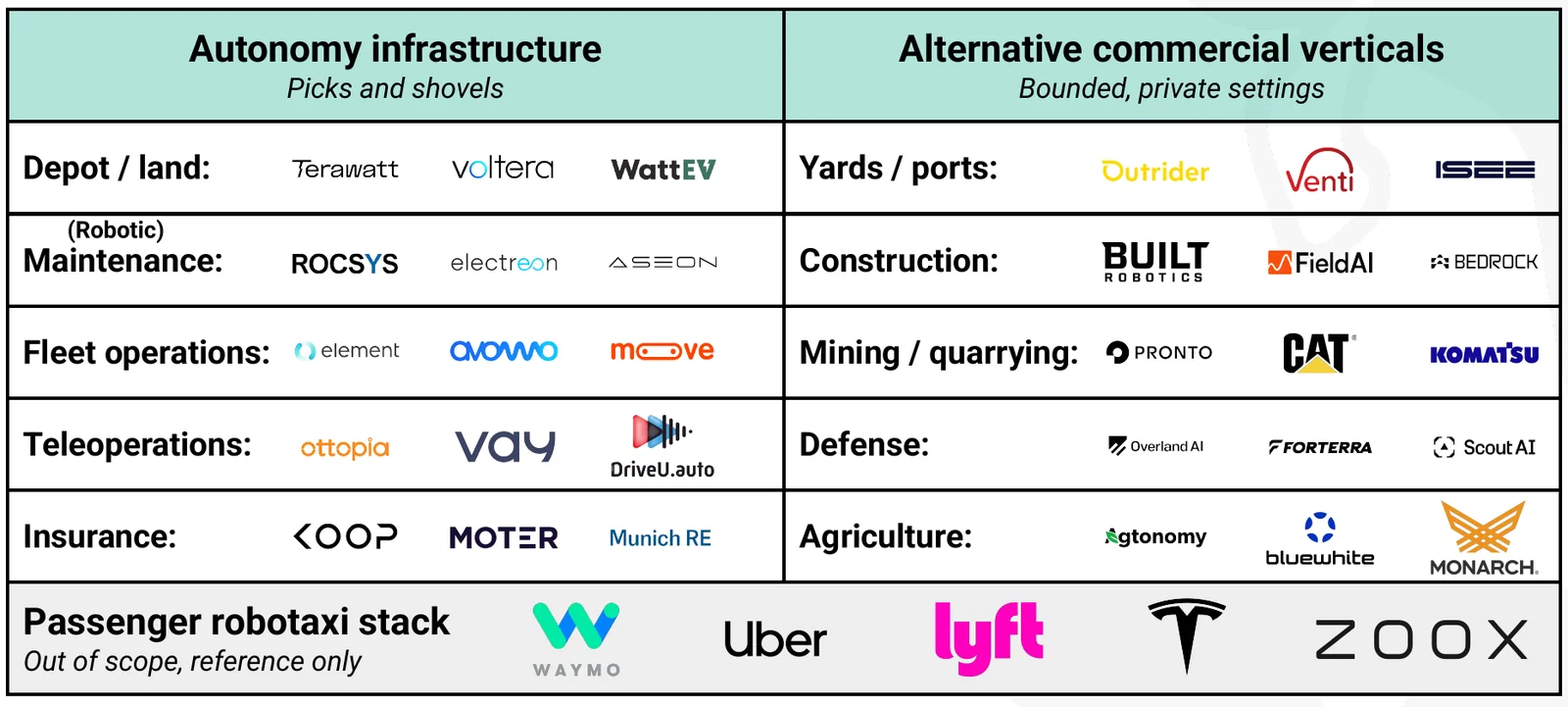
Robotaxis get the headlines. Over the past two months, we mapped the economy forming around them: ten segments spanning autonomy infrastructure and the bounded commercial verticals where driverless already works. The map below shows the landscape. What follows is what we found about how it is structuring itself.
1. Autonomy is a deployed industry, not a demo
400K+
Paid driverless rides Waymo runs per week. It raised $16B in February 2026 at a $126B valuation.
200+
Trucks Aurora is targeting by the end of 2026. Its freight already runs in Texas with no human on board.
Today
Driverless yard trucks are moving trailers inside US distribution centers right now.
The three deployment fronts behave differently. Passenger robotaxis are a consumer service, with Uber aggregating rides from multiple developers. Driverless freight runs on public highways, with developers licensing “driver” software to truck makers instead of owning trucks. Off public roads, autonomy is quietly commercial: ports, mines, and farms lead because they are private, fenced, and slow. Policy reinforces the commercial path: the 2025 US federal AV framework enables commercial deployment, FMCSA is exempting automated trucks from hours-of-service rules, and the EU is harmonizing type-approval around use cases like automated parking and hub-to-hub freight.
2. The robotaxi core is consolidating. The dynamics differ by region
UNITED STATES
Shaped by capital.
$21.4B went into 34 deals, and the top three players took roughly 82% of it. Capital is concentrating quickly around the leaders.
CHINA
Shaped by national champions.
Baidu's Apollo Go passed 350K weekly driverless rides in March 2026. Pony.ai and WeRide are exchange-listed.
MIDDLE EAST
Shaped by the sovereign buyer.
The state sets mandates, grants permits, and assigns fleet operators, with technology imported from abroad.
EUROPE
Shaped by incumbents.
The EU sets a technical baseline, but sign-off is national or regional, and the same global players are racing.
3. Around the core, asset owners absorb the software
This was the clearest pattern across all three deep dives. The standalone, operations-adjacent software layer keeps getting pulled inside whoever owns the physical asset, the customer relationship, or the balance sheet. In fleet operations, Element acquired Autofleet for roughly $110M and then won Waymo's fleet-operations contract, so one company now owns both the software and the physical operations relationship. In yards, Kalmar bundles orchestration software directly into the chassis with an estimated 20–25% market share, and ISEE partnered with TICO for distribution. In insurance, Tesla and Waymo self-insure the data-rich core, and Aon acquired Humn.ai's technology rather than compete with it. So far, pure software or data layers sold to a handful of incumbents have typically exited around the $100M mark: meaningful outcomes, and a pattern worth designing around.
The pattern in one line: own the vehicle, the customer, or the balance sheet, and the software layer comes to you.
4. Three shifts worth watching
A. Insurance is being rebuilt as a real-time data problem.
As liability moves from drivers to manufacturers, underwriting moves from personal auto (demographics, credit) to product and AI liability. The century-old actuarial base breaks: AV fleets carry a thin, non-stationary loss history, and every software update makes some of the old data obsolete. The data-rich players already route around the traditional market. Tesla underwrites its own vehicles, with roughly $1.4B in 2025 premium, and Waymo carries its own policy directly with a reinsurer. Notably, Tesla's insurance arm ran a ~100.4% loss ratio in 2025 (S&P Global), a sign of how hard this new risk class is to underwrite, even with rich data. The pool shifts rather than shrinks: Goldman Sachs estimates AVs could halve US auto-insurance spend by 2040, with value migrating toward performance data and risk selection.
B. Bounded domains reach driverless economics first.
Yards, ports, mines, and farms are private, fenced, and slow, so a vehicle can simply fail-stop without public-road clearance. That is why driverless arrived there first, and why retrofitting existing fleets gets to revenue faster than OEM-native autonomy. The US has roughly 30–40K terminal tractors installed, with $100–200K+ of addressable labor per truck per year. But the segment is consolidating fastest of all: OEM bundles are absorbing the orchestration layer, and OEM serial production of autonomous yard trucks is targeted for 2026–27. It is a real market, but a smaller one where the window is moving quickly.
C. Fleet operations collapses into the asset owner.
Robotaxi developers outsource physical operations wholesale, city by city, to asset-heavy operators, while keeping the high-value software (dispatch and demand prediction) in-house. Trucking splits cleanly: the AV developer keeps the “driver,” and the carrier owns the fleet and runs it on conventional platforms. Horizontal incumbents like Samsara (~$1.75B ARR), Motive, and Fleetio already hold the buyer relationship and offer AV features as a near-free upsell. No third-party, AV-native operations seat has emerged between these players yet, and acquired-tooling outcomes to date have clustered near $100M.
5. What can stay independent
The space that remains open is narrow but real. Across every segment we studied, the strongest independent companies tend to share five structural traits:
- Multi-OEM and vendor-neutral by design. A single-OEM data feed is replicable and eventually absorbed by that OEM.
- Owns the customer, with revenue tied to usage or premium, not software licenses sold through someone else's relationship.
- Capital-light. No vehicles, land, or balance-sheet risk; asset-owning startups end up competing with incumbents on incumbent terms.
- Serves the fragmented long tail that the data-rich leaders leave open as they focus on their own fleets.
- Compounds a cross-fleet data gap that no single incumbent can close on its own.
The autonomy economy is consolidating around asset owners, but real space remains for independents that are cross-fleet, customer-owning, and capital-light. Building here? We would love to hear from you: blackhornvc.com.
Sources: PitchBook; S&P Global Market Intelligence; NACFE; Goldman Sachs Research; Swiss Re; NHTSA / FMCSA; European Commission; Waymo, Aurora, Baidu, Element, Kalmar, Aon and other company announcements (2023–2026). Figures are estimates from public reporting. This summary is provided for informational purposes only. It is not investment advice, an offer of securities, or a recommendation regarding any company mentioned.


